
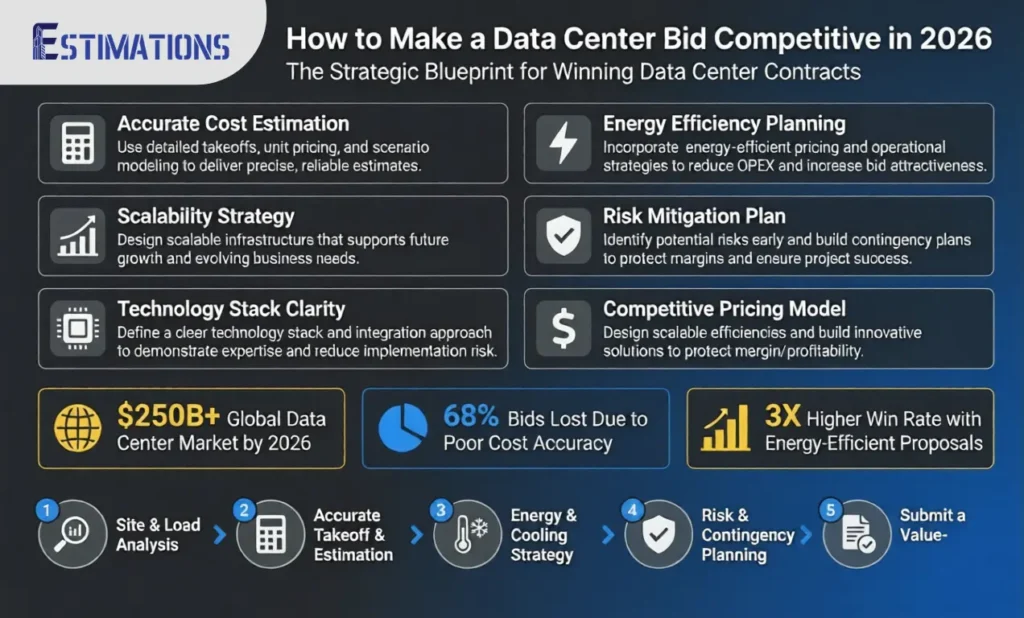
As a contractor, you know that estimation decides the way your project will go. This becomes more critical when you bid on a data center project. Why? Because of massive cost volatility per megawatt (MW), the need for high-density cooling systems, location specifications, IT infrastructure evolution, and industrialized, prefabricated construction.
Furthermore, project owners and managers have become more qualified; using AI, they get industry insights and go deep into the details, demanding you prove that you understand the project in depth.
This means there is no table available to put the details from the last project. Now, your bid must show the real-world requirements of the project, highlighting criticals, like system coordination, procurement timing, commissioning pressure, and access limits. Let’s understand how to make your data center bids look competitive in 2026.
1. Read the Project Scope Like a Risk Analyzer
This means read the drawings expertly by putting your focus on the followings:
- A responsibility matrix that shows a chart that defines who owns, does, or checks specific tasks and deliverables.
- An addendum that shows modifications, updates, or additions made to the contract documents after they were released for bidding but before the contract is signed.
- Utility notes that show instructions, rules, and requirements on connection points for electricity, water, gas, telecommunications, and sewer systems
- Commissioning language that shows the processes required to verify, document, and test that all mechanical systems operate according to the Owner’s Project Requirements (OPR).
Including these, look for tie-in windows, shutdown limits, security rules, and scope split points between trades.
Note: If your document leaves room for some clarification points, do add uncertainty and estimate it according to the project scope.
2. Work on Power Before You Estimate
Power availability holds a major seat in data center estimation. Consider a site for a data center project, looking simple and inexpensive on paper. But when you arrive on site, you see many ignored details regarding the utility path that is overloaded, unclear, and slow. Do you know what it can lead to? Drop your project quality and also delay it.
This means you must account for power equipment in the estimates early. See what to add in the electrical elements:
- Switchgear
- Transformers
- Feeders
- Backup generation
- UPS gear
3. Understand the Cooling Needs
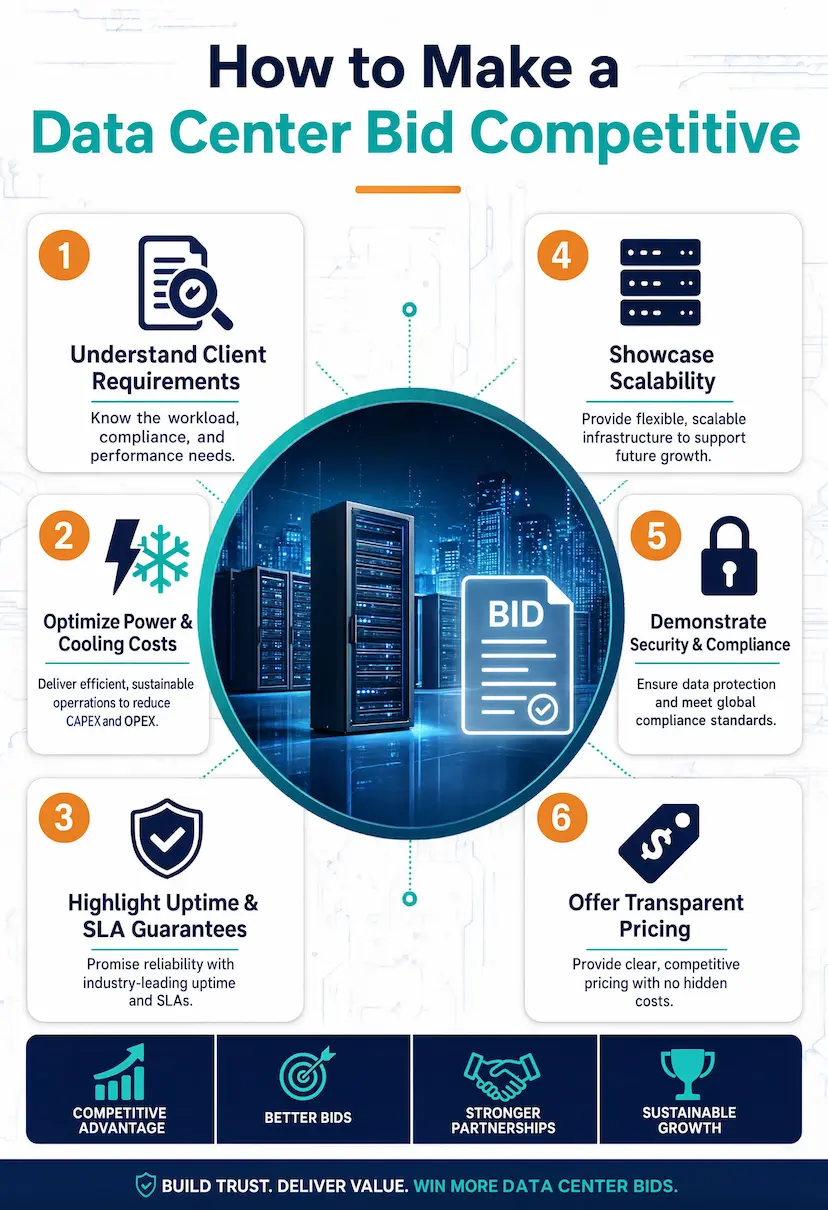
Cooling is no longer a side system; however, it now shapes the data center building, the sequence, and the cost. Before 2026, traditional racks with 5kW−10kW were enough. But in 2026, data center projects need high-density or cloud with a 10kW−30kW range. Even 40kW-100+kW AI/GPU racks are used today. And this high-density IT load is changing the cooling infrastructure of data center projects.
Prefer Liquid Cooling Systems Over Air-Only Cooling Systems
Data center cooling systems come in 2 major types: Liquid cooling systems and Air-only cooling systems. Comparing both, the liquid cooling system stands first. Why? Because of…
- Superior thermal conductivity
- Top-notch density support
- Better energy savings
- Unmatched space optimization
- Hardware systems longevity
4. Add Long-Lead Packages in a Separate Budget Sheet
Long-Lead Packages are also called Long-Lead Equipment or LLE. These packages include custom, mission-critical hardware and MEP (Mechanical, Electrical, Plumbing) systems that require extensive manufacturing and shipping times. Most of the time, they take 12 to 18 months or more, and thus significantly impact the targeted project schedule. Therefore, you can’t consider them a side expense in estimates.
LLE needs its separate attention, notes, and assumptions for data center competitive bidding. When estimating this factor, ensure to add the following points in the plan:
- Vendor quotes
- Delivery windows
- Freight assumptions
- Storage conditions
- Buyout timing
Benefits Data Center LLEs Estimates Bring for Contractors
You can see LEEs in an internal review and benefit from the followings:
- Reduced financial risk on-site
- Fewer supply chain issues
- Streamlined labor allocation
- Better time management
5. Estimate the Labor Smartly
Consider the union variations, pay & incentives, geographic wages, LLEs schedules, modular & prefabricated MEP systems, and commissioning + testing needs when estimating the labor cost for competitive data center bidding. Including these, there are some more factors that affect the labor cost indirectly. These include:
- Per diem
- Travel
- Recruitment
- Supervision
- Workforce housing
So, add both (exposed and hidden), so you can bid with confidence, ensuring you win the data center contract.
Get the data center estimates done right and ensure you win with us!
6. Match the Bid Structure to the Contract
It is something that highlights risk in plans. You can see what has been estimated, plus what it includes and excludes from the plan. Matching the bid structure to the contract becomes more essential when you rely on the CM-at-risk delivery method, where a construction manager acts as an advisor during the design phase and then transitions into a general contractor. They commit to delivering the data center within a Guaranteed Maximum Price (GMP), considering the financial risk for any cost overruns.
How to Structure a Data Center Bid According to the Contract?
- Match the bid structure to the delivery model, including Design-Bid-Build (DBB) or Design-Build (DB) & EPC.
- Map out, define, and schedule your purchasing and sourcing strategies
- Aligning project completion goals with the financial and legal accountability to integrate commissioning milestones with liabilities
- Shift from fixed-cost models to agile, risk-adjusted frameworks to account for tariffs and supply chain volatility
- Translate IPD (Integrated Project Delivery) principles, including Multi-Party Agreements, Vendor Involvement (EVI), Virtual Design & Digital Twins, Target Value Design (TVD), Co-location, and Lean Commissioning.
Also, separate…
- Owner-furnished equipment from contractor-procured scope
- Design development risk from supply chain risk
- Startup support from the base install
This way, you can make your proposal easily readable and understandable for your clients.
Note: If your contract allows, add escalation clauses to avoid rising material costs affecting construction bids, extreme lead times for critical equipment, and severe skilled labor shortages.
7. Factor in Escalation With Real-World, Real-Time Conditions
The time has gone when data center bidding only depends on hard costs. In 2026 war conditions, data center projects are facing physical supply issues and escalating geopolitical and trade pressures. Approximately 50% of planned U.S. data center capacity for 2026 is facing delay or cancellation. Equipment lead times and power availability issues are causing this delay. As a contractor, you must consider escalation into the estimates, using the following methods:
- Lock in pricing for long-lead items (transformers, chillers) 18 to 22 months in advance of deployment to avoid spot-market premiums.
- Build contingency buffers for insurance premiums and supply chain disruptions.
- Factor in the capital costs of on-site energy generation and liquid cooling infrastructure, as hyperscalers push for self-sufficient, high-density environments.
- Avoid relying on historical square-foot pricing and use updated data benchmarks.
8. Estimate the Data Center Construction Schedule
Coming to project schedule estimates, add procurement, fabrication, delivery, installation, testing, and owner review time in the chain. Ensure accuracy in each phase because if one slips from the schedule, the rest will be affected. And to ensure accuracy in each, consider the followings in estimates:
- LLEs risks
- Tier classification
- Commissioning complexity
- Permitting & approval time
Furthermore, you can play some smart moves to align the plan with the targeted project schedules: Involve subcontractors early in the design phase; use collaborative platforms; and factor in sustainability metrics. When all the above points are combined, your project timeline estimates will enable you to get favorable results while meeting project schedules.
9. Get Estimating Support from a Trustworthy Resource
You can see many companies providing building estimating services to contractors. Those who ensure your win through their estimates use some unique strategies when making a budget plan for your data center project. They use proven methods to identify scope gaps, vendor exposure, and sequence risk before estimation starts.
Remember that this is only possible when you join forces with a certified estimator. When an estimator who understands how to estimate the construction cost goes into the depths of the project scope, he makes your construction seamless by eliminating all the budget-related issues.
10. Review Details Before Bid Submission
Whether you estimate the project yourself or outsource construction bid estimating services to a team, review the details before submission. Check all allowance, exclusion, and clarification notes, and check them against the contract structure and the procurement path. Above all, keep the plan updated all the time. If something changes, update the estimates instantly, and repeat the review process for verification in each number.
Before everything, identify whether the project is worth it to bid, saving time, money, and resources.
How to Make a Right Bid/No Bid Decision
Not every opportunity deserves a full estimate. Some jobs look good until the documents reveal too much missing scope or too much schedule risk. Before the team spends hours on takeoff, your bid-no-bid review should answer a few questions.
- Does the firm understand the project type?
- Can the team support the schedule?
- Are the long-lead items clear?
- Are the commissioning expectations manageable?
If the answers keep shifting into maybe, the job may not be worth the estimating time.
Checklist for a Competitive Data Center Bid Package
- Accurate quantity takeoff completed for every trade
- Utility coordination assumptions are clearly explained
- Commissioning support is included in the estimates
- Closeout and turnover requirements covered
- Long-lead equipment and procurement risks addressed
- Temporary power, cooling, and site needs are considered
- Construction phasing and sequence reviewed
- MEP systems coordinated with the actual drawings
- Structural and roof support requirements checked
- Site access, deliveries, and logistics planned out
- Allowances, exclusions, and assumptions are clearly listed
- Material escalation and pricing risks acknowledged
- Schedule constraints and lead times reviewed
- Major project risks identified early
- Scope built around the real data center requirements
- Bid clarifications written clearly and directly
- Labor approach and staffing assumptions defined
- Testing, startup, and final turnover included
- Permit and inspection coordination reviewed
- Final bid package checked for gaps, conflicts, and missing scope
Conclusion
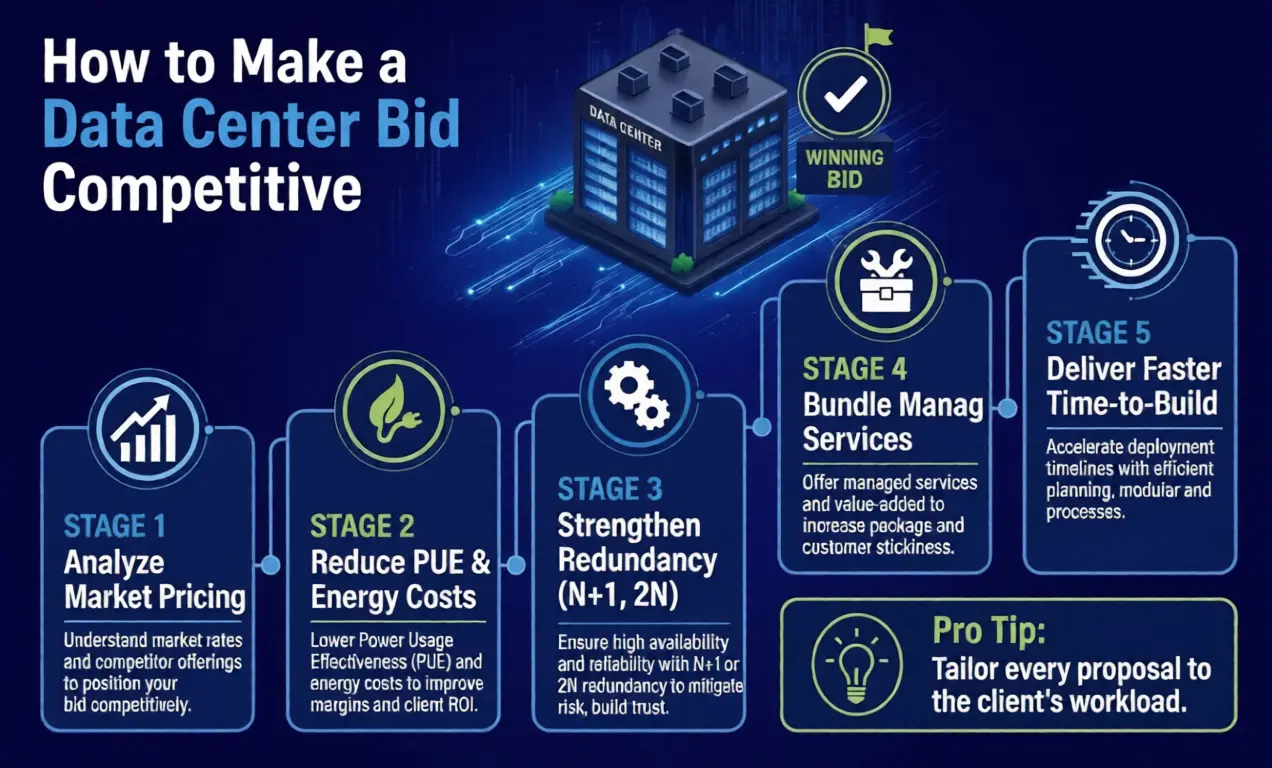
A data center competitive bid in 2026 is about being accurate under pressure. Higher density, tighter coordination, and longer procurement lead times have changed the data center bidding game. Today, only those bids win that consider power limits, schedule reality, labor availability, procurement timing, and the current geographical conditions. So, estimate everything precisely, so that you meet your bid-winning goal. And for professional budgeting support, Estimations should be your go-to. The firm has been estimating construction projects for 20+ years and has generated 1000+ successful results.
Frequently Asked Questions
When to lock vendor pricing in data center estimates?
As early as possible. The longer the team waits for the electrical and cooling systems costs, the more room the market has to move against the estimate.
What data center bid mistakes affect the contractor’s margin the most?
Labor misestimation and missed long-lead exposure; both mistakes show up in the field, leading to rework.
What to look for in utility connections for a datacenter project?
Look for interconnection timeline, outage windows, utility ownership boundaries, and testing duties. All these factors affect both project cost and schedules.
Do I need to add contingency in all bids?
Yes, but make sure that the contingency matches the particular project risk. Keep design uncertainty separate from procurement uncertainty, so make estimates readable.
What clarification list should be added for a data center bidding?
Target work scope gaps, schedule conflicts, and ownership questions; they all affect the project cost the most.
What to see more than the data center construction cost in the bid?
Look for experience, sequencing logic, and a realistic path through a startup; they all streamline delivery.
