
~75-98% of the construction projects in North America encounter delays due to multiple reasons. Their timeline recorded shows that they extended by 37% longer than estimated. When any construction project duration extends, contractors and builders see a significant effect on the project coordination and total cost. And delays in construction are unfilterable. To professionally deal with this, you must know how to analyze and calculate the construction delay claims. Let’s start with the types of delays!
What are the Common Types of Delays in Construction?
Some construction delays are avoidable, some are not. Similarly, some delays are made by the construction team, and some by the project owner himself. Explore each type below!
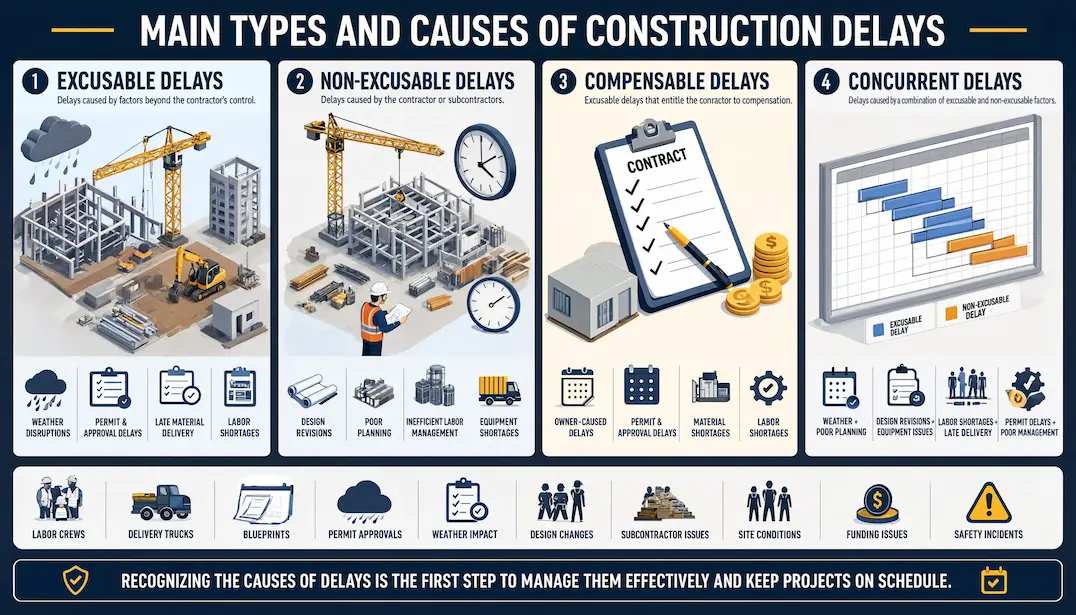
1. Excusable Delays
As the name suggests, “excusable”, these are the delays that a contractor can’t control. For example, bad weather, owner-directed changes, force majeure events, and certain permitting delays.
Coming to extension, sometimes contractors get a time extension without money; sometimes the delay is both excusable and compensable. You must know the difference between the two so you can add the right statement in the claim.
2. Non-Excusable Delays
These are the delays opposite to excusable ones, which means contractors can control them. And they are made from the contractors’ side. Examples include poor sequencing, late procurement, weak supervision, missed workforce targets, and subcontractor failure.
Unlike excusable delays, these delays usually do not support a time extension or extra compensation. In many contracts, they can also trigger liquidated damages or backcharge exposure if the owner can show the late finish came from the contractor’s own performance.
3. Compensable Delays
Under excusable delays, we mentioned “compensable”, which means eligible for payment. Compensable delays are the costly ones. They happen when the owner or another responsible party causes a delay, and the contract allows money recovery.
Examples include late drawings, late approvals, owner interference, or change orders. These are the events that can significantly disrupt the planned sequence (critical path). Coming to reimbursable amounts, contractors can recover extended overhead, labor inefficiency, equipment standby, and escalation tied to the added time.
4. Concurrent Delays
Next comes concurrent delays; it is where both teams are involved in the construction delay, and the dispute gets messy. It mostly happens when two delay events overlap during the same period, and both affect the schedule at once.
For example, the owner issues a late design change while the contractor suffers a procurement miss on a critical material. Both events combine and affect the project’s actual timeline.
What are the Major Causes of Construction Delays?
As mentioned in the introduction, there could be a bundle of reasons behind a delay in construction. Here are the common ones discussed.
1. Labor Shortages
Between 349,000 and 500,000 workers are required in the US to meet the current construction market demand in 2026. This shows labor is already short, which means slow production. When a workforce is not available on site, activities stop, and project schedules get affected. This also means the slippage of the critical path.
In addition to slow production and project delays, labor shortages also increase the local wage. Currently, it is $18 to $72+ per hour. And it is where the project timeline issue becomes a budget problem.
2. Procurement Delays
Suppose you have a workforce ready to start work on site, but the required critical materials, including structural steel, MEP equipment, and IMP, are still on the way. No building materials means an inability to start construction on time. To efficiently deal with that, you must know its root causes:
- Tariffs
- Trade policy
- Global conditions
- Skilled labor short
- Increasing infrastructure demand
And coming to delay claims, your file must show when the order went out, when the vendor confirmed delivery, and when the delay actually hit the work.
3. Design Changes
Labor is on site, procurement is on time, but construction blueprints have some issues now. This means the need for revised detail, RFIs, and scope changes while the team is ready to start work with all required materials available (as per the last version of construction takeoffs) on site.
Now, the blueprints will be redesigned, and till then, labor will sit idle, and equipment rentals will be wasted. And after you have new blueprints, you might need more or different construction materials, which means procurement again. All these events delay a construction project.
Coming to construction delay claims, keep strong records so you can prove to project owners that design changes have affected the project timeline.
4. Permit Delays
It is considered nothing, but it can shake the construction project’s complete schedule. One delayed approval means delayed mobilization, inspections, utility tie-ins, or occupancy milestones. As a contractor, you must track every submittal date, comment cycle, and resubmission, so you can tell a real story to the owner, supporting claims.
5. Weather Impacts
Raining on a day with no weather-sensitive activity? No problem. But if it is raining during earthwork, roofing, or concrete placement, you have to stop the work. In that situation, keep contemporaneous proof with daily logs, weather reports, photos, and schedule updates to support your claim when required.
How to Manage a Construction Project Schedule?
Like professional construction project managers, use CPM scheduling. This benefits from AI in construction to automate scheduling, optimize resource allocation, and mitigate project delays. Explore more below!
What Is CPM Scheduling?
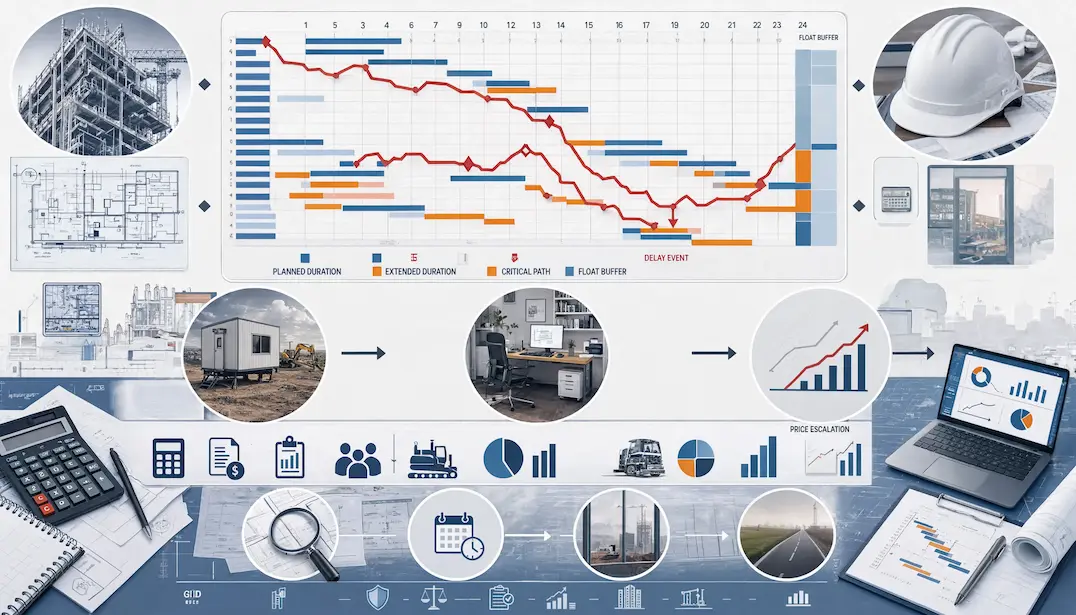
In “compensable delays”, we mentioned “critical path”, which means the longest connected chain of activities. And CPM stands for Critical Path Method. It is a scheduling method that maps the order of the connected activities, durations, and dependencies that affect project due dates.
If one activity on the critical path gets delayed, the finish date can also be delayed. In that case, you can claim a delay using CPM. It shows the real-world effects of the particular event on a construction schedule.
Critical Vs Non-Critical Path
Remember that not all activities in a construction project are a part of the critical path. Some are individual and do not affect the timeline of other activities—for example, landscaping. A delay only becomes powerful when it touches the critical path or consumes float that the team needed later—for example, foundation work.
What is Float in Construction Scheduling?
Float is the scheduled free room between an activity’s early and late dates. It gives the project flexibility to absorb minor delays without affecting the construction project due date.
But once the float has been used, the next delay starts affecting the finish line. And it is where contractors need to file claims. With CMP analysis, you can track where the float went, who used it, and whether the project still had enough room to recover.
What are the Common Methods to Analyze Construction Delay?
There are multiple methods available; you must use the one according to the project scope and your preferences. Here is a table for a quick analysis.
| Method | Best Use | Strength | Limitation |
| As-Planned vs As-Built | Quick early review | Simple and easy to explain | Weak on causation and concurrency |
| Time Impact Analysis | Ongoing projects with updates | Shows the effect on the live schedule | Needs clean updates and good discipline |
| Windows Analysis | Long jobs with monthly updates | Breaks delay into periods | More work, but more defensible |
| Measured Mile Analysis | Productivity and disruption claims | Uses actual performance data | Needs a clear, unimpacted baseline |
| Forensic Schedule Analysis | High-value disputes | Deepest schedule review | Time-consuming and document-heavy |
Explore more on each method.
Get Expert Construction Delay Claim Analysis & Cost Support.
● As-Planned Vs As-Built Analysis
As the name shows, the method has 2 parts: as-planned and as-built. In this analysis, you compare the original schedule to what actually happened to identify where the delay occurred. For this type of analysis, you must have clear records of data; otherwise, you can’t file a strong claim.
● Time Impact Analysis (TIA)
Using this method, teams insert a delay event into the live schedule update. This explains what affected the finish date of the construction project. When you maintain regular, reliable CPM updates, this method supports your construction delay claims by showing how and for what duration a certain factor affected the project schedule.
● Windows Analysis
Windows analysis breaks the construction project into time periods, then studies delays within each period. As you see inside each phase, you get where the critical path was affected as the work progressed. Simply put, you read a full story using this method and find the cause of the delay, particularly in long, complicated projects.
● Measured Mile Analysis
It is where you analyze the construction delay by considering the productivity during the actual project schedule and the delayed hours. By determining the difference between the two, you can see where the efficiency was lost during the project lifecycle. This method works well for disruption claims tied to labor inefficiency, resequencing, congestion, or interference. It does not rely on broad assumptions the way some other methods do.
● Forensic Schedule Analysis
As the name reflects, forensic schedule analysis reviews schedules, updates, logic ties, float movement, and contemporaneous records to reconstruct what really delayed a construction project’s completion. It shows why a project is delayed and who’s responsible for that. And it is the best option when the stakes are high and the dispute is headed toward mediation, arbitration, or litigation.
How to Calculate Construction Delay Claims?
Follow the process below:
1. Conduct Construction Schedule Analysis
Using CPM software and the most suitable method of analysis (discussed above), analyze the project schedule. Forensic schedule analysis is the best option and is suggested by the industry experts.
2. Categorize the Delay
Check the root cause of the construction delay and name it between Excusable Compensable, Excusable Non-Compensable, and Non-Excusable.
3. Calculate the Financial Damages
This must include:
- Field office overhead cost
- Home office overhead costs
- Price escalations
Field Office Overhead
Field office overhead covers the jobsite costs, including superintendent time, trailers, field admin, utilities, phones, safety, and temporary facilities.
Use this formula for calculation:
Daily field office rate x days of compensable delays
Note: Support the calculation with records.
Home Office Overhead (HOOH)
Home office overhead is the headquarters cost that supports the business while the project stays open longer than planned. This cost category becomes important when the delay keeps central staff, accounting, cost/budget estimating, project management, or executive support tied up longer.
It is calculated with the Eichleay Formula.
Allocable HOOH = (Contract Revenue/Total Company Revenue) x Total HOOH
Daily Rate = Allocable HOOH/ Original Contract Duration
Total Damage = Daily Rate c Days of Compensable Delays
4. Estimate the Escalation
This must include data on materials, labor, equipment, and other necessary components. When a construction project gets delayed, it needs escalation, which is the adjustment of contract prices due to increases in material, labor, and equipment costs over time.
Use this formula for escalation of materials and labor costs.
Material/labor escalation = actual material cost − planned material cost
For equipment, use this equation:
Equipment damage = extended equipment cost + idle time cost − discounts
Note: Increasing materials cost also affects construction bids, deciding your win and your margin.
How to Make a Construction Delay Claim Powerful?
Ensure solid construction documentation, supported with CPM. Keep the following documents updated all the time:
- Baseline Schedule: It shows the original plan, the planned sequence, and the contract completion date.
- CPM Schedules: They capture logic changes, critical path shifts, and recovery attempts as the project progresses.
- Daily Reports: This includes labor, weather, work performed, delays, deliveries, and
- RFIs and Change Orders: They show why the plan changed, plus connect the delay event to a formal project action.
- Meeting Minutes: They keep warnings, approvals, and unresolved issues.
- Cost Records: They include the payroll reports, vendor invoices, equipment logs, cost code summaries, and job cost reports.
What Mistakes to Avoid in Building Delay Claims?
- Poor documentation, which means the failure to maintain accurate, contemporaneous, and organized project records.
- Missing schedule updates, which means a lack of the weekly/monthly revisions to a project’s baseline schedule.
- Late claim submission, which means a contractor fails to provide a Notice of Delay or formally submit a detailed Extension of Time (EOT) claim within the strict contractual deadlines.
As a contractor, you might lack expertise in all that, and it is where estimators’ assistance changes the game.
How Cost Estimators Help With Construction Delay Claims?
They connect scheduled events to the actual cost of the construction project. That sounds simple, but here you need estimating expertise to play with numbers of times and costs. By going into the depth of project delays and impact on cost, they bring reports that support your claims. And most prominently, you can save a lot of time and money with their assistance.
Get Assistance from Estimations to Successfully Claim a Construction Delay Loss!
All construction projects are susceptible to delays; some are controllable, and others are not. Once they happen, contractors need to work on construction delay claims, which are formal contractual requests for additional time, financial compensation, or both.
Your claim must be solid, supported with proven track records and numbers (both are challenging and time-consuming). A better option is to outsource services to estimation experts; the team will handle everything from identifying the root cause of delays to estimating the damage cost. Meanwhile, you can focus on construction rather than dealing with the headache of project delays.
Support Your Claims with Reliable Estimating Services Now!
FAQs
How to write a construction delay claim?
First, review the contract and identify notice provisions, time extension clauses, and no-damage-for-delay clauses. Then, establish entitlement, which means documenting the cause of delays and categorizing them. Next, assess the impact of the delay on the project timeline, and lastly, calculate the damage.
How to avoid construction delays?
Start with the completely ready designs, eliminating the chances of redesigning. Order long-lead construction materials early and request permits without delays. Most importantly, give each activity a room, adding 10-20% float.
What are the L1, L2, L3, and L4 in the construction schedule?
In construction management, there is a hierarchy of timelines, ranging from high-level executive summaries to daily, task-based execution plans.
L1: Project Master Schedule
L2: Management Summary Schedule
L3: Project Coordination Schedule
L4: Execution Schedule
What is the best way to pursue or defend claims?
The best approach for pursuing or defending claims requires relying on 3 points. All are interconnected: Detailed documentation provides the facts, strict notice secures your contractual right to compensation, and establishing the critical path proves that an event actually delayed the final project timeline.
What is meant by excusable but non-compensable construction delay?
An excusable non-compensable delay occurs due to unforeseeable events (force majeure, severe weather, government actions) beyond both parties’ control. The contractor receives a time extension only, no additional compensation, absorbing idle costs, extended overhead, and resource downtime independently.
