

Do you know what the major problem contractors and estimators are facing nowadays in the US? It is a rising material cost. Whether you talk about steel, lumber, aluminum, or copper, everything is turning the results of projects that were seen as profitable at some time. Factors that are causing this rise include tariffs, supply chain delays, global demand, and labor shortages. Their combined force affects the contractors’ bids, making bidding more challenging than ever.
When this issue affects contractors, it eats their profits. Furthermore, rising material costs lead to excess change order requests, project delays, and damaged client trust, which is unacceptable to any contractor. Whether you overprice or underprice the construction materials, both lead to unfavorable outcomes.
Well, you are here to get why construction materials costs increase, how the increase in them affects the contractors’ bids, and the strategies to align them with the best outcomes every contractor wishes for. Let’s start the discussion in detail!
Why Construction Material Prices Keep Rising
Even a 20% increase in the material price can reduce profit by half or more. Therefore, it is mandatory to understand the material cost drivers. This is the only way that allows you to control it and keep it within your budget limits.
Below are the key drivers that increase the construction material costs.
● Tariffs & Trade Policies
Major import materials’ tariffs remain a major factor in this game. Even domestic materials are affected by this factor since the increased rate of imported materials forces suppliers to increase the local prices.
For example, steel mill products increased by over 13% in 2025, while aluminum mill shapes spiked 22.8%.
● Supply Chain Disruptions
Global logistics challenges are another factor that leads to delays and shortcuts. When manufacturing slows down, ports experience congestion and trucking capacity is also affected, which ultimately leads to rising material costs due to late arrival.
● High Demand Across Sectors
Whatever the kind of project, residential, commercial, or industrial, all compete for the same materials. This leads to higher demand for materials, that increase their prices in the market. Additionally, this situation sometimes leads to an extra increase in costs when supply is disrupted or delayed.
● Labor Shortages in Manufacturing & Logistics
When the factories, ports, and transport network have fewer workers in the labor team, this slows down the production process. This causes delays in the project timeline and increases the material costs due to urgent needs. In this situation, contractors pay for the premiums or wait for materials, affecting project costs and timelines.
● Transportation & Fuel Costs
Fuel prices fluctuate in intervals, directly affecting the construction materials shipping costs. And if the materials are coming from a long distance, the freight rates will be higher. For heavy and bulk materials, like steel beams, concrete, and lumber, this can add thousands of dollars to your project budget.
● Global Economic Instability
You might ignore this factor, but currency fluctuation, geopolitical issues, and the international demand cycle affect the construction materials costs.
How Rising Material Costs Affect Construction Bids
Do you know that nonresidential construction input costs rose ~3.2% YoY in 2025, while key commodities like copper, aluminum, and steel spiked by over 13–22%, a reality contractors can’t ignore when preparing bids.
If you are considering the materials costs as a background issue, you must understand that it can significantly affect your bids, contracts, and project profitbaility. Constructions that are hit by rising material costs often experience waste of money and time, ultimately losing the client’s trust.
Let’s see how increasing material rates affect the construction bids!
● Reduced Bid Accuracy
As a contractor, you must know that the bids are prepared weeks or months before bidding. This increases the chances of adding outdated data into your proposal. And if you go with wrong estimates, this means you will lose the project.
Let’s understand it with an example! A contractor submitting a bid for a commercial construction project calculates steel at $1,200 per ton, only to see the price increase 15% before purchase. That $180 per ton increase leads to thousands of dollars of unexpected expense, potentially damaging the profit.
● Lower Profit Margins
Some contractors come with fixed prices; they play an important role in increasing the impact of rising material costs. When a contract is done with a fixed price, the contractor has to bear all the changes in material rates. This sometimes increases the profit but mostly decreases it.
● Increased Competitive Pressure
Contractors mostly try to keep bids low to increase their winning chances. But when rising material costs hit this, the tension becomes doubled. In this situation, the contractor might win the project but leave a little room for cost overruns, which ultimately affects their profit. This can be sought by continuously refining pricing strategies.
● Project Delays & Cash Flow Impact
Material shortages or delayed deliveries affect project schedules, which causes labor downtime and increases overhead. For example, if copper wiring is backordered for several weeks, electricians may be idle, adding indirect costs that aren’t included in the original bid. Extended timelines also tie up cash flow, which can stop other construction projects.
● Change Orders and Contract Adjustments
When material costs rise unexpectedly, contractors often need to issue change orders or negotiate contract modifications. Without escalation clauses or flexible contract structures, these adjustments may not be fully recoverable, leaving contractors absorbing the extra expense. Poorly documented adjustments can also lead to disputes with clients.
● Broader Effects on Project Viability
High material costs can make some projects financially unfeasible. Owners may scale back the scope, delay projects, or cancel entirely when bids exceed their budget. Insurance premiums can also rise because higher material costs increase project values, further squeezing margins.
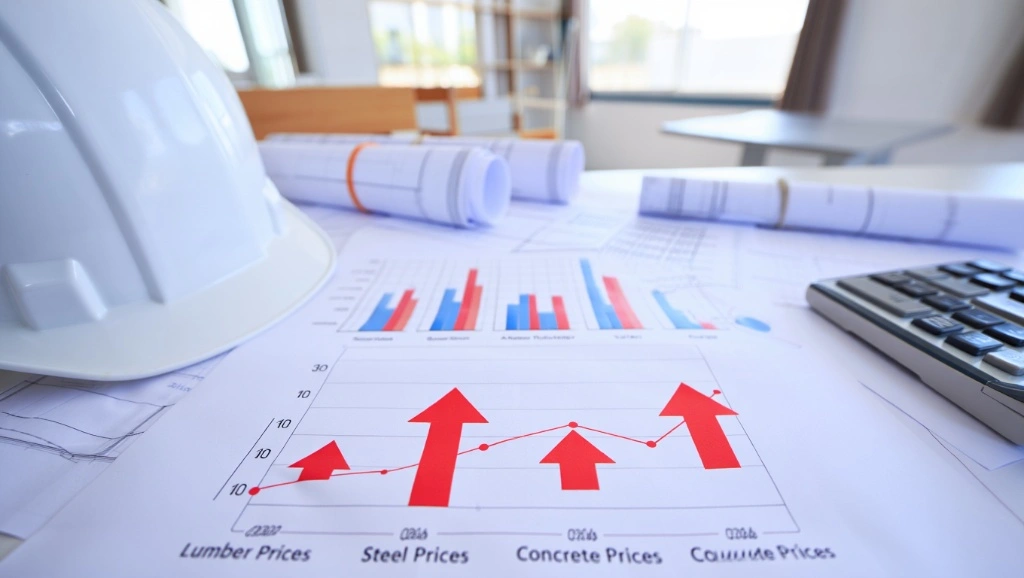
Construction Material Cost Trends: What the Data Shows
Material price inflation doesn’t come from a single source. Each major construction material is affected by a different mix of market forces, which is why price behavior varies so widely.
Copper prices, for example, are heavily influenced by global demand and limited supply. Electrical infrastructure, renewable energy projects, and data centers all compete for the same copper inventory. When overseas demand rises or mining output tightens, U.S. pricing reacts almost immediately.
Tariffs and production constraints impact aluminum mill shapes. Even when sourced domestically, aluminum pricing reflects higher input costs and reduced manufacturing capacity. This makes pricing especially unstable for window systems, curtain walls, and façade elements.
Import tariffs, energy costs, and labor shortages at mills shape steel pricing. Structural steel and rebar pricing often increases in waves rather than gradually, which makes it difficult to forecast accurately during long bid cycles.
Lumber behaves differently. Housing demand, transportation bottlenecks, and seasonal supply shifts drive its pricing. This results in sharp spikes and drops, creating volatility rather than steady inflation.
At a broader level, nonresidential and overall construction input costs rise due to a combination of material inflation, transportation expenses, and supplier markups. The Producer Price Index reflects this cumulative pressure rather than isolated commodity movement.
| Material/Cost Indicator | YoY Change (2025) |
| Copper wire & cable | +22% or more |
| Aluminum mill shapes | +22.8% |
| Steel mill products | +13%+ |
| Lumber & wood products | Highly volatile |
| Nonresidential construction inputs | +3.2% YoY |
| Overall construction inputs | +2.8% YoY |
| Construction materials PPI index | 338–344 |
How These Drivers Translate Into Real Bid Risk
These price drivers directly shape bid outcomes.
When electrical materials increase in price, contractors face higher costs in wiring, panels, and conduit that may not be recoverable under fixed-price contracts. Aluminum and steel increases raise structural and envelope costs, which are difficult to value-engineer late in the design phase.
Volatile lumber pricing creates uncertainty in framing estimates, forcing contractors to either add contingencies or risk underbidding. Broad input cost inflation increases insurance premiums, bond values, and financing costs, compounding the financial exposure.
Most importantly, historical pricing becomes unreliable. Unit rates that worked six months ago may already be outdated, leading to margin erosion even when quantities are accurate.
Escalation Clauses: Your First Line of Defense Against Material Price Spikes
Escalation clauses have become essential in today’s construction market. When material prices can move double digits within months, locking yourself into a fixed material cost without protection is a calculated risk, and often an unnecessary one.
At a basic level, an escalation clause allows the contract price to adjust if material costs increase beyond a defined threshold. Instead of absorbing the full impact of a spike in steel, copper, or aluminum, part of that risk is shared with the owner.
Why Escalation Clauses Matter?
The biggest problem with traditional fixed-price contracts is timing. Bids are submitted weeks or months before materials are purchased. During that gap, prices can rise sharply, especially for long-lead or globally traded commodities.
Without an escalation clause, contractors are forced into one of two bad options:
- Inflate bids with large contingencies and risk losing the job, or
- Bid aggressively and absorb cost increases later.
Escalation clauses solve this by reducing uncertainty. They allow you to submit a competitive base bid while still protecting your margin if market conditions change.
How Escalation Clauses Work?
Most escalation clauses are tied to an objective, that is, a third-party index. Common references include:
- Producer Price Index (PPI) for construction materials
- Commodity-specific indices for steel, copper, or aluminum
- Documented supplier quotes at the time of purchase
A typical structure includes:
- A baseline price that is established at bid submission
- A trigger threshold (for example, 5–7% increase)
- A calculation method for price adjustments
- Clear documentation requirements
Only increases beyond the threshold are eligible for adjustment, which reassures owners that the clause isn’t a blank check.
Best Practices for Using Escalation Clauses
- Apply them only to high-volatility materials (steel, copper, aluminum, lumber)
- Keep thresholds reasonable to avoid owner pushback
- Reference widely accepted indices, not internal pricing
- Limit escalation to documented increases at the time of purchase
- Pair clauses with defined bid expiration dates
Used properly, escalation clauses protect margins without killing competitiveness. They’re a strategic tool for bidding responsibly in an unstable market.
Does Locking in Material Prices Early Work?
Locking in material prices early is one of the most common strategies contractors use to manage cost fluctuation. When it is done right, it can protect margins and bring certainty to a project. But if it is done poorly, it can create cash flow problems and introduce new risks.
The key is knowing when price locks make sense and when they don’t.
When to Locking Material Prices?
Early price locking works best under specific conditions:
- High-confidence projects where an award is likely, and timelines are clear
- Long-lead materials such as structural steel, switchgear, or specialty aluminum systems
- Predictable quantities with finalized drawings and minimal design risk
- Stable supplier relationships that can guarantee delivery and pricing
For example, if you’re bidding a commercial project with a 6–9 month steel lead time and strong owner commitment, locking pricing early can prevent major exposure if steel prices rise before procurement.
The Hidden Risks of Early Material Price Locks
Despite the upside, early price locks are not risk-free. Here are some of its related risks.
● Cash Flow Risk
The most common issue is cash flow strain. Suppliers often require deposits or full payment to hold pricing, tying up capital that could be used elsewhere. For smaller contractors, this can limit the ability to take on additional work.
● Schedule Risk
There’s also schedule risk. If a project is delayed or canceled, locked materials may no longer align with revised timelines, creating storage costs or contract disputes.
● Scope Change
Another overlooked risk is scope change. If quantities shift after pricing is locked, contractors may be forced to buy additional material at higher spot prices, undermining the original hedge.
Best Practices for Locking Material Prices Early
To reduce risk, contractors should:
- Lock prices only after drawings reach a high level of certainty
- Negotiate time-bound locks rather than open-ended commitments
- Align material locks with contract award milestones
- Confirm cancellation and adjustment terms in supplier agreements
- Avoid locking prices on low-volatility or easily substitutable materials
Smarter Bidding Practices
When material prices are volatile, the structure of your bid matters just as much as the numbers inside it. Contractors who rely on the same bidding approach they used in stable markets often find themselves either losing jobs or losing money. Smarter bidding practices help manage risk without sacrificing competitiveness.
● Use Bid Expiration Dates Strategically
One of the simplest and most effective protections is a clear bid expiration date. Material pricing can change quickly, and bids that stay open indefinitely expose contractors to unnecessary risk.
Most contractors now limit bids to 15–45 days, depending on market conditions and material exposure. This approach:
- Forces timely decision-making by owners
- Allows repricing if material costs shift significantly
- Reduces the chance of honoring outdated pricing
Expiration dates are especially important for projects with high steel, copper, or lumber content.
● Build Realistic Buffers, & Not Guesswork
Adding contingency is unavoidable in volatile markets, but the key is precision, not padding. Blanket contingencies applied across the entire project often make bids uncompetitive.
A better approach is material-specific buffers:
- Higher contingencies for volatile materials
- Lower or no contingencies for stable items
- Separate allowances for long-lead components
For example, adding a 5–7% buffer to steel and copper while keeping finishes tighter helps protect margins without inflating the entire bid.
● Focus on Shorter-Term & Phased Projects
Projects with shorter durations are naturally less exposed to price swings. When possible, contractors may prioritize:
- Fast-track projects
- Phased construction with early material procurement
- Jobs where materials can be purchased shortly after the award
This doesn’t mean avoiding large or complex jobs, but it does mean recognizing that longer timelines carry higher material risk and should be priced accordingly.
● Separate Volatile Materials as Line Items
Breaking out high-risk materials as separate line items or allowances improves transparency and flexibility. It also simplifies change orders if prices increase after award.
Owners are often more receptive to adjustments when volatile materials are clearly identified upfront rather than buried in lump-sum pricing.
● Choose the Right Jobs to Pursue
In volatile markets, not every project is worth bidding. Estimators consider:
- Material intensity of the scope
- Duration between bid and procurement
- Owner flexibility on contract terms
- Availability of escalation or cost-sharing mechanisms
Walking away from high-risk projects can be just as important as winning new ones.
Protect Your Profit Margins—Get Expert Construction Estimating Support Now!
Flexible Contract Models
Fixed-price contracts have long been the standard in construction, but in periods of extreme material volatility, they often shift disproportionate risk onto contractors. When material prices are unpredictable, flexible contract models can provide a more sustainable path forward.
The Limits of Fixed-Price Contracts
Fixed-price agreements work best in stable markets with predictable material costs and short procurement timelines. In volatile conditions, they can quickly become a liability. If steel, copper, or aluminum prices spike after bid submission, the contractor absorbs the increase unless protections are in place.
This pressure often forces contractors to inflate bids with contingencies, which can make them less competitive or invite scrutiny from owners.
The Role of Cost-Plus Contracts
Cost-plus contracts allow contractors to recover actual material costs plus an agreed fee. This structure transfers much of the material price risk to the owner while maintaining transparency.
Cost-plus models are especially effective for:
- Long-duration projects
- Projects with evolving designs
- Work involving volatile or specialty materials
To succeed with cost-plus contracts, contractors must maintain detailed cost tracking and clear communication with owners. Transparency is critical to maintaining trust.
Time-and-Materials (T&M) Agreements
Time-and-materials contracts offer even greater flexibility—contractors bill for actual labor hours and material costs, typically with predefined markups.
T&M works well for:
- Renovations and retrofit projects
- Emergency or fast-track work
- Scopes that are difficult to define upfront
However, T&M contracts require strict documentation and may face resistance from owners seeking cost certainty.
Hybrid Contract Approaches
Many contractors now use hybrid models that blend fixed pricing with flexible elements. For example:
- Fixed pricing for labor and predictable materials
- Cost-plus or allowance-based pricing for volatile materials
This approach balances competitiveness with protection and is often easier for owners to accept than fully open-ended contracts.
Communicating Contract Choices to Owners
The success of flexible contracts depends on communication. Contractors should explain:
- Why volatility makes fixed pricing risky
- How flexible models prevent inflated bids
- How transparency protects both parties
When positioned correctly, flexible contracts are not a weakness; they’re a professional response to market reality.
About Material Substitution & Value Engineering
When material prices surge, protecting profit doesn’t always mean raising bids or shifting risk through contracts. In many cases, the most effective solution is rethinking material choices early through value engineering and smart substitution.
The goal isn’t to cheapen the project. It’s to meet performance, safety, and code requirements at a lower and more predictable cost.
What Value Engineering Means
Value engineering is often misunderstood as cost-cutting late in the project. In reality, it works best during estimating and preconstruction, when material decisions are still flexible.
Effective value engineering focuses on:
- Functional equivalency
- Lifecycle cost, not just upfront price
- Availability and lead times
- Installation efficiency
A slightly different material that installs faster or has more stable pricing can outperform the original specification from a cost perspective.
Contractors who proactively suggest cost-stable alternatives often gain credibility with owners. Instead of reacting to price increases, they demonstrate control, foresight, and partnership.
In volatile markets, value engineering isn’t optional; it’s a strategic tool that helps maintain margins while keeping projects viable.
Common Material Substitution Opportunities
Certain scopes are more flexible than others. Common opportunities include:
- Alternative framing systems or steel gauges
- Aluminum versus composite façade components
- Different insulation types with equivalent R-values
- PVC or PEX piping instead of copper, where permitted
- Precast or modular components to reduce labor and waste
Each substitution must be vetted against project specs, local codes, and owner expectations, but many substitutions are approved when supported by clear documentation.
Timing Matters
Substitution discussions should happen before bids are finalized or contracts are signed. Late-stage substitutions often trigger redesign costs, delays, and owner resistance.
Estimators who flag high-risk materials early can collaborate with designers and owners to explore alternatives before pricing is locked in.
How to Manage Approval & Risk?
To avoid disputes:
- Document performance equivalency clearly
- Provide manufacturer data and certifications
- Get written approvals before procurement
- Coordinate substitutions with suppliers and installers
Unapproved substitutions can create liability, even if they reduce cost.
Strong Supplier Relationships
In periods of rising material costs, suppliers aren’t just vendors; they’re risk partners. Contractors who treat procurement as a transactional activity often pay more, wait longer, and absorb greater volatility. Those who invest in supplier relationships gain pricing stability, reliability, and leverage.
Why Supplier Relationships Matter
When materials are scarce or prices are moving quickly, suppliers prioritize customers who offer consistent volume, clear communication, and timely payments. Strong relationships can result in:
- Preferential pricing or price holds
- Early access to limited inventory
- Faster delivery schedules
- Better insight into upcoming price changes
This information alone can give estimators a critical edge during bidding.
Long-Term Agreements & Volume Commitments
Contractors may negotiate long-term supply agreements or volume-based pricing. These arrangements help smooth price fluctuations across multiple projects rather than absorbing volatility job by job.
Even partial commitments, such as locking pricing for a quarter or for a specific material category, can significantly reduce exposure.
The Case for Multi-Sourcing
Relying on a single supplier increases risk. Disruptions, backorders, or sudden price increases can leave contractors with no alternatives.
Multi-sourcing allows contractors to:
- Compare pricing across vendors
- Shift procurement if supply tightens
- Maintain leverage during negotiations
Coordination Between Estimating & Procurement
One common failure point is the disconnect between estimating and purchasing. Estimators may assume pricing or availability that procurement cannot secure.
Regular coordination ensures:
- Quotes used in bids are current and realistic
- Lead times are accurately reflected
- Escalation risks are identified early
This alignment reduces surprises after the award.
Additionally, procurement decisions made under pressure often cost more. Contractors who plan purchases strategically, track supplier trends, and negotiate proactively are better positioned to protect profit.
Use Technology & Real-Time Pricing to Reduce Risk!
In a volatile pricing environment, spreadsheets and static cost databases are no longer enough. Contractors who rely on historical averages are consistently exposed to underbidding and margin erosion. Technology has become one of the most effective tools for controlling material cost risk.
Why Real-Time Pricing Matters
Material prices now change faster than traditional estimating cycles. Copper, steel, and aluminum can shift significantly between bid preparation and procurement. Real-time or frequently updated pricing allows estimators to:
- Validate supplier quotes before submission
- Identify abnormal price movement early
- Adjust contingencies based on current market conditions
The Use of Digital Takeoffs & Centralized Cost Databases
Modern estimating software integrates quantity takeoffs with live or frequently updated cost data. This reduces manual errors and ensures that material quantities and unit rates stay aligned.
Centralized databases also help teams:
- Maintain consistency across bids
- Update pricing once instead of across multiple files
- Track cost trends by material and trade
This is especially valuable for firms bidding on multiple projects simultaneously.
Forecasting and Trend Tracking
Advanced tools allow contractors to track historical price trends alongside current data. This helps estimators recognize when a price increase is part of a long-term trend rather than a short-term spike.
Forecasting tools don’t predict the future perfectly, but they help estimators make informed decisions about:
- Contingency levels
- Escalation thresholds
- Whether to lock pricing or stay flexible
How to Reduce Human Error and Subjectivity
Technology doesn’t replace estimator judgment; it supports it. Automated checks, updated databases, and standardized workflows reduce reliance on assumptions and memory.
This consistency becomes critical as material volatility increases and estimating teams face tighter deadlines.
Outsourcing a Professional Construction Estimating Service Provider is a Good Option.
Some contractors have turned to outsourcing estimating as a strategic response to material volatility. Partnering with professional estimators, providing construction estimating services, allows building firms to maintain accuracy, speed, and competitiveness without overloading internal teams.
Why Outsourcing Makes Sense?
Outsourced estimating provides several advantages:
- Access to Updated Pricing: Professional estimators use real-time supplier data and commodity indices, ensuring bids reflect current market conditions.
- Advanced Tools and Expertise: Firms gain access to digital takeoff software, cost databases, and trend analytics without large capital investments.
- Scalable Support: Estimating teams can scale up for large projects or tight deadlines without permanent staffing increases.
- Reduced Risk of Margin Erosion: With accurate quantity takeoffs and pricing, contractors are less likely to absorb unexpected cost increases.
How Does It Work in the Real World?
When outsourcing, contractors provide project drawings, scope documents, and any relevant material assumptions. The estimating partner:
- Performs detailed quantity takeoffs
- Applies current pricing and material trends
- Builds contingencies for volatile items
- Delivers a complete, professional bid package
This allows contractors to submit competitive, profit-protected bids while keeping internal resources focused on project management, procurement, and field work.
Final Thoughts
Rising material costs are no longer a temporary disruption; they’re a permanent challenge for U.S. contractors in 2026. From steel and copper to lumber and aluminum, price spikes can erode margins, delay schedules, and turn profitable projects into financial risk.
The solution isn’t simply raising bids. Contractors who thrive combine data-driven estimating, smart contract structures, strategic procurement, material optimization, and professional expertise. Each strategy addresses a different angle of risk: from early price locks and escalation clauses to value engineering and supplier partnerships.
Accuracy, foresight, and flexibility are now competitive advantages. Contractors who integrate these approaches not only protect their margins but also strengthen client trust, win more projects, and position themselves for growth.
If you want to stay ahead in 2026’s volatile market:
- Track real-time material prices and commodity trends
- Include escalation clauses and contingency buffers in bids
- Optimize materials with value engineering
- Leverage professional estimating services to reduce errors and improve bid accuracy
Outsourcing or using advanced estimating tools ensures your bids are precise, your margins are protected, and you can focus on executing projects, not chasing cost surprises.
Don’t leave profit to chance. Make your estimating process a strategic advantage.
To stay competitive and accurate in bidding despite rising material prices, rely on professional services from our construction estimating services!
And if you want to explore more on this topic, start reading Construction Material Price Forecast 2026: Inflation, Tariffs & Bid Cost Impact Explained!
Commonly Asked Questions
What materials are highly affected by inflation in 2026?
- Lumber (construction framing and plywood)
- Steel (structural, rebar, roofing)
- Aluminum (mill shapes, siding, windows)
- Copper (wiring, piping)
- Concrete and cement
- Drywall, roofing materials, and insulation
What is the escalation clause in construction estimation?
An escalation clause in construction estimation is a contract provision allowing price adjustments if material costs rise beyond a set threshold. It protects contractors from unexpected cost increases, ensuring bids remain profitable without overpricing initially.
What is the difference between price locks and escalation clauses?
Price locking and escalation clauses are not mutually exclusive. In fact, they work best together. Price locks protect against short-term spikes, while escalation clauses cover longer-term or unexpected market shifts.
What is the benefit of outsourcing estimators?
In markets with rising material costs, outsourcing isn’t just a convenience; it’s a competitive advantage. Contractors who leverage external expertise can bid more accurately, protect margins, and respond quickly to material price changes, benefiting from the expertise of outsourced estimators.
