
Imagine losing a profitable construction project because your offer was not outstanding, right? To win construction bids in 2026, it is not about luck or low bids; construction bidding is not all about figures, but all about the strategy, accuracy, and time. Bidder contractors who base their bidding process on data as a business activity continue to win over the competition, with an insulated margin and superior projects.
Why this matters now:
- Increased competition and reduced margins.
- Increased requirement for accuracy, speed, and transparency.
- Make the most out of your profit.
- Eliminate expensive errors of estimation.
- Achieve more competitive projects.
Are you also tired of making guesses and beginning to win smarter bids? Keep reading.
Introduction
The building industry has never been as difficult as it will be in 2026. Minimal margins and stiff competition, coupled with tight project timelines, mean that one bid might or might not make your business profitable. The role of construction bidding importance goes way beyond the provision of numbers; it is now a strategic measure to win valuable projects.
- Contractors have 5-8 bid competitions on average per project.
- The overall industry win rate is just 25%, which means that precision and planning have become very crucial.
- With proper estimating and planning, you are bound to win at least 40-50% of the time based on the best record contractors.
The construction cost analysts at Estimations.us will write this guide and demonstrate how you can make your bids a profit-generating system and not paperwork.
What Is Construction Bidding, and Why Does It Still Define Success?
A prepared bid is the key to every successful construction project, and most contractors still do not pay enough attention to it. Construction bidding refers to the ability to enter a project through a comprehensive proposal that gives specifications on the cost, schedules, and plans of the project. It is not only that you can give the lowest price, but a manifestation of your planning, knowledge, and the capacity to get true value. Indeed, those contractors that bid on a value-based bid, which is a cost-quality-risk balance, usually win more compared to contractors who make price-only bids.
Why Bidding Matters?
- Bids are used by the contractors to show competency and trustworthiness, rather than cost.
- Projects are, on average, given 5-8 competitive bids, and therefore clarity and strategy are important.
- The value-based bids are based on quality, schedule management, and risk reduction and tend to be more successful than price-only bids.
Price-Only vs. Value-Based Bids
Although the Low-Bid Method (awarding to the lowest responsible bidder) is likely to be used on public projects, the industry is switching to Best Value Selection (BVS).
| Feature | Price-Only Bids | Value-Based Bids |
| Primary Goal | Lowest initial cost. | Long-term ROI and project quality. |
| Evaluation | Comparison of bottom-line figures. | Weighted score like 30% price, 70% qualifications. |
| Ideal For | Simple, repetitive projects. | Complex builds, data centers, and retrofits. |
| Risk | High risk of change orders and delays. | Lower risk due to early contractor involvement. |
How does the Construction Bidding Process Work?
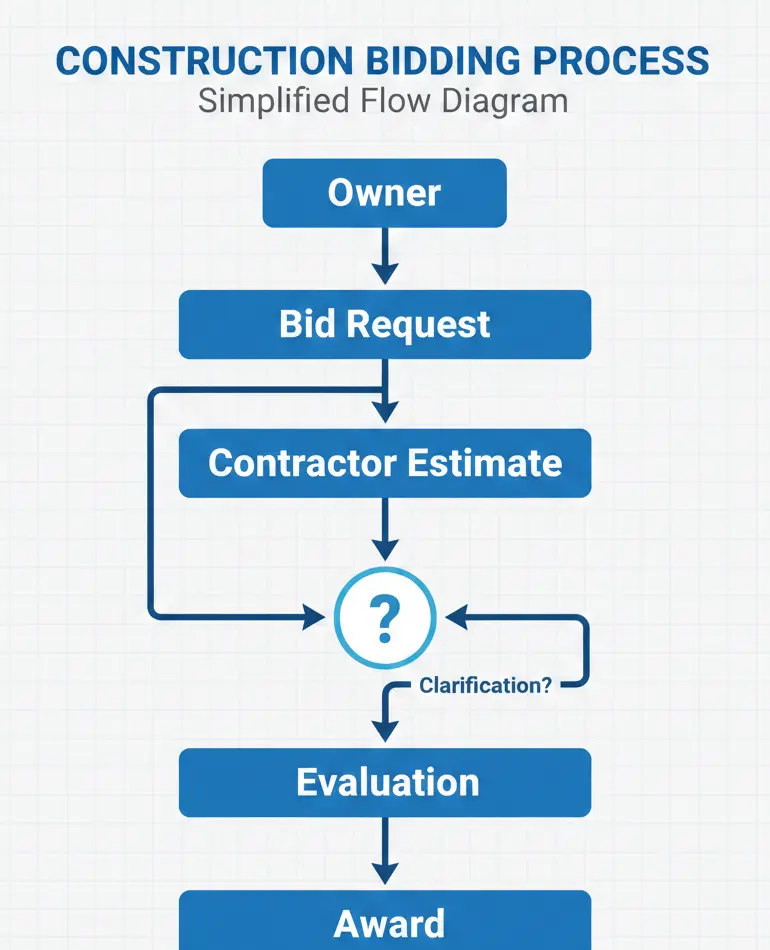
This is simply a strategic process:
- Bid Request: The owner or developer determines the scope of the project.
- Contractor Estimate: Contractors estimate costs, resources, and schedules.
- Evaluation: Proposals are verified in terms of accuracy, feasibility, and value.
- Award: The cheapest, quality, and experience-wise, bid usually wins.
Contractors need to incorporate accurate estimating in their bid preparation strategy in order to come up with a winning bid. Understanding what construction estimating involves in the provision of a realistic estimation of costs, time frames, and resource distribution. Contractors with organized estimating behaviour have a higher chance of winning competitive bids by 1520 percent since their bids show credibility and experience. This makes bidding a system that determines profits to be a reality and not a piece of paper.
Why Construction Bidding Is More Competitive Than Ever in 2026?
The construction industry in 2026 is not the same as it used to be. It is a stronger competition, shortened time frames, more critical owners of projects than ever, and it can scarcely be won on a mere low-price bid. The fact is that contractors tend to lose at least three & four out of five bids because there is a low contractor bid win rate of 25. This reveals that it is not just a matter of undercutting your opponent to win these days; it is a matter of strategy, precision, and credibility.
Most projects have competition for the same contract, with an average of 5 to 8 contractors competing for the same contract. This is the level of competition that puts the contractors to the challenge of making their proposals outstanding by delivering value, being clear, having a realistic plan, and not necessarily the lowest price. Low prices are no longer sufficient, and bids that cannot consider project complexity, risk, and allocation of resources are usually dismissed without any second chances.
It is important to understand such construction bidding trends in 2026 to enable any contractor to win lucrative projects. The bid analysis, enhancement of estimating accuracy, and making clear and professional proposals allow contractors to have a higher chance of winning and eliminate costly mistakes.
| Number of Bidders | Average Win Probability |
| 2 | 50% |
| 5 | 25% |
| 8 | 12% |
Who’s Involved in Construction Bidding?
Contractors on average compete 5-8 per project with 2-4 vital subcontractors.
- Owners/Developers: State scope, budgets, and expectations.
- Contractors/Estimators: White offers comprehensive plans and precise budgets, and deadlines.
- Subcontractors/ Suppliers: Specialise in pricing and input of materials.
- Project Managers: Make sure that bids meet schedules and resources.
Types of Construction Bidding
- Open Bidding: Every qualified contractor can put in a bid; very competitive.
- Closed/Invited Bidding: Invited contractors only are put into consideration; further tactical.
- Negotiated Bidding: The contractor and the owner come into the contract by conducting a mutual negotiation.
- Design-Build Bidding: only one entity is involved with both design and construction; it is more dynamic and faster in nature.
Open bidding is the method of approximately 60% of all public construction projects, and design-build has been increasing at an average of 10% per annum.
| Type | Who Participates | Pros | Cons |
| Open Bidding | Any contractor | Transparent, competitive | High competition |
| Closed/Invited | Selected contractors | Better quality control | Limited competition |
| Negotiated Bidding | Owner + Contractor | Collaborative, flexible | Risk of bias |
| Design-Build | Single entity | Faster, integrated | Higher upfront cost |
Key Factors That Make a Construction Bid Stand Out
- Accurate Estimating: Combine finer quantities and schedules.
- Organization and Professionalism: Documents are in order.
- Value Proposition: Strengths, risk management, and schedule keeping.
- Risk Mitigation: Have contingency planning in case there are changes in the scope, or you start falling behind.
- Technology Adoption: BIM or AI is better to use for accuracy and presentation.
Strategies for Developing a Winning Bid
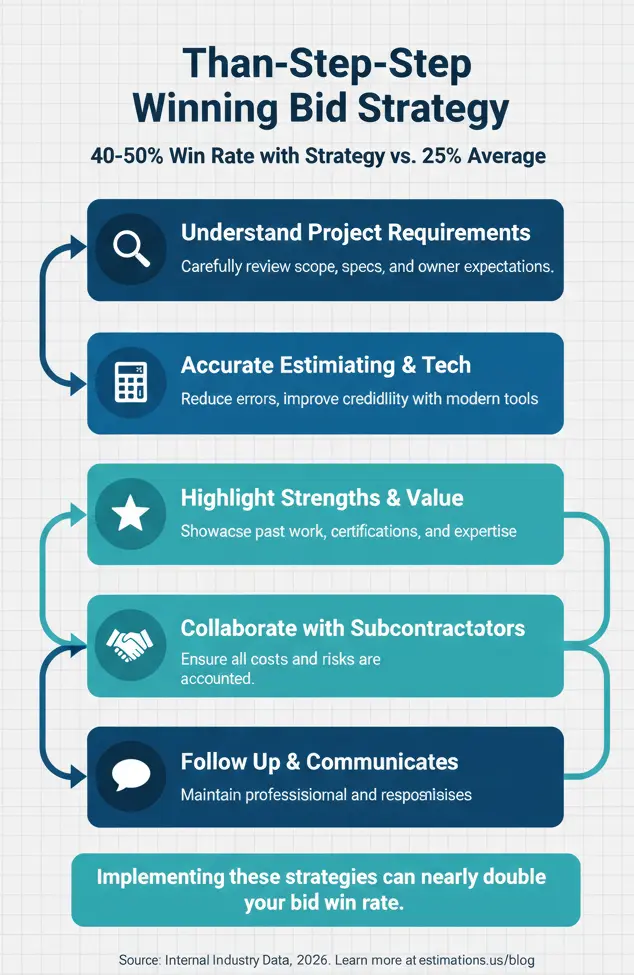
Contractors who implement strategic bid review and collaboration see win rates of 40-50% in contrast to 25 on average.
- Understand Project Requirements: Weeks of scope and specs, carefully reviewed.
- Application: Use the Right Estimating Tools: Minimise errors, enhance credibility.
- Hot Strengths: Include the past projects, credentials, and rare knowledge.
- Collaborate with Subcontractors: See that all the costs and risks are taken into consideration.
- Follow Up & Communicate: Be professional and responsive.
The Direct Link Between Bidding, Estimating & Profitability
In construction, the estimating is equal to the cost of the bid. Proper construction estimating and bidding directly affect profitability, though research has established that 60% of construction tenders are underestimated, and 70% of projects are overruns. These estimations are not only dangerous in terms of winning the bid, but also destroy margins, cause project stress, and even make a profitable project a loss.
The significant antidote to eliminating such traps is to integrate expert estimating habits. They can come up with proposals that are realistic, competitive, and strategic when the contractors are made aware of how construction estimating supports bidding. Through a thorough assessment of materials, labor, schedule, and contingency costs, estimators are able to ensure that the bid prices are based on the actual project costs and minimize any unexpected occurrences and profitability.
| Estimating Quality | Bid Result | Profit Impact |
| Poor | Lose or underbid | Loss |
| Average | Break-even | Low |
| Accurate | Competitive win | High |
This table demonstrates the very basic yet very important rule, which is that the more accurate your estimation, the greater the probability of being the winner in profitable bids. Proper estimates enable entrepreneurs to compete effectively without having to lose money in a bid to get contracts, and as a result, every successful bid will add to a good margin and growth.
Estimating → bid price → profit risk connection is no longer an option in the current competitive market. Contractors who base their pricing on a meticulous assessment and systematic estimating techniques not only increase their rates of wins but also protect their bottom line, and bidding to gain profit is not speculative anymore.
How Win Rates Affect Revenue Proved by Real-Life Example?
Suppose that a contractor makes 20 bids a month. They would only have 5 projects, considering that the industry average win rate is 25%. On the one hand, it is great to get some of the jobs, but 15 opportunities that may have been missed can have an extremely negative effect on revenue and growth. What would happen to the improvement of bid accuracy, strategic estimating, and value-based proposals: a win rate of 40% will turn into 8 projects, which is 60% more revenue with no extra bids being submitted.
This simple example shows a cardinal fact: the increase in the quality of bids and bidding strategy can lead to a significant profit increase. Through combining correct estimating, competition, and strategic proposal presentation, contractors are giving themselves a better chance to win as well as to secure their margins.
In the current competitive market, contractors who overlook the relationship between estimating, bid strategy, and win rates may be leaving a lot of revenue on the table. On the other hand, individuals who maximize each proposal with accuracy and understanding make every bid a source of profits. This is the strategy that will distinguish mediocre contractors from the best ones in 2026.
Common Bidding Mistakes Contractors Still Make
Experienced contractors occasionally get into traps, which cost projects and profits. The initial move towards winning better and increasing the margins in construction bidding is to understand the mistakes.
Underpricing to Win
Even though it can be considered a fast way of securing projects, it is imperative to note that under-pricing can lead to a reduction in the profit margins and even lead to losses in the event that costs associated with the project are higher. In fact, it has been realized that 60% of the construction bid is underestimated, and hence the significance of proper pricing to make a profit.
Ignoring Scope Gaps
Incomplete bids could be caused by not considering all the factors in a project, such as unique conditions of the site, material changes, or other needs. Contractors who fail to notice scope gaps face rejection or disagreements in the course of execution. The correct cost estimation of construction bids will help avoid unexpected costs and make it more credible by covering all possible expenditures.
No Contingency Planning
Contingency planning is not taken into account by the contractors, and they are vulnerable to delays, unexpected costs, or supply chain problems. Nearly 7 out of 10 construction projects are realizing cost overruns, contingency in your bid is not an option, and you will need to keep profits and maintain the project on time.
Poor Documentation
An unclear bid, poorly formatted, or one of which important details in professionalism and disqualifies a contractor from consideration. The accuracy of bids and profitability is not achieved by just numbers but by how they are presented in a clear and structured manner. Clarity and impact could be enhanced through the use of templates and the incorporation of structured estimating methods.
These are some of the pitfalls that contractors can avoid by contractors to have a high chance of winning in the competitive bids. Knowing the reasons why contractors lose the bids, learning to estimate accurately, plan meticulously, and pitch the bid professionally will turn an ordinary bid into a business profit and growth weapon.
How Technology and AI Are Reshaping Construction Bidding?
The construction sector is undergoing a radical change. The faster, more precise, and increased win rates are witnessed in contractors who adopt AI in construction bidding and modern construction bidding technology. The manual approach to bidding is being substituted with a digital workflow, predictive analytics, and intelligent estimating tools, which guarantee that contractors deliver profitable, competitive bids every time.
Improving Accuracy with BIM and Cloud Estimating
The BIM (Building Information Modeling) enables any contractor to develop elaborate digital versions of projects. It not only enhances cooperation but also raises the accuracy of estimates by more than 15%. Cloud estimating tools go a step further to allow real-time updating of labor, materials, and cost, increasing the accuracy by approximately 20%. Combining these tools will allow the contractors to avoid underestimating the project, manage the risks, and present the offer that would be the most profitable.
|
Contractors who are aware of how AI in construction aids in bidding can apply the technologies to maximize the precision and speed of their bids. |
AI-Powered Insights and Predictive Analysis
The current AI applications are more than just computation. They determine data from past projects, market dynamics, and bid data to give forecasts. Pricing strategies, the potential risks, and the allocation of resources can now be identified by the contractors before placing a bid. This allows the proposals to be competitive and minimize the chances of making costly mistakes, and assists the contractors in maintaining margins and win rates.
Construction Bidding Software You Can Use
In order to introduce such technologies, there are a few tools that are favored in the industry. The software is used to improve estimating, to plan the project, and to manage the bid:
PlanSwift
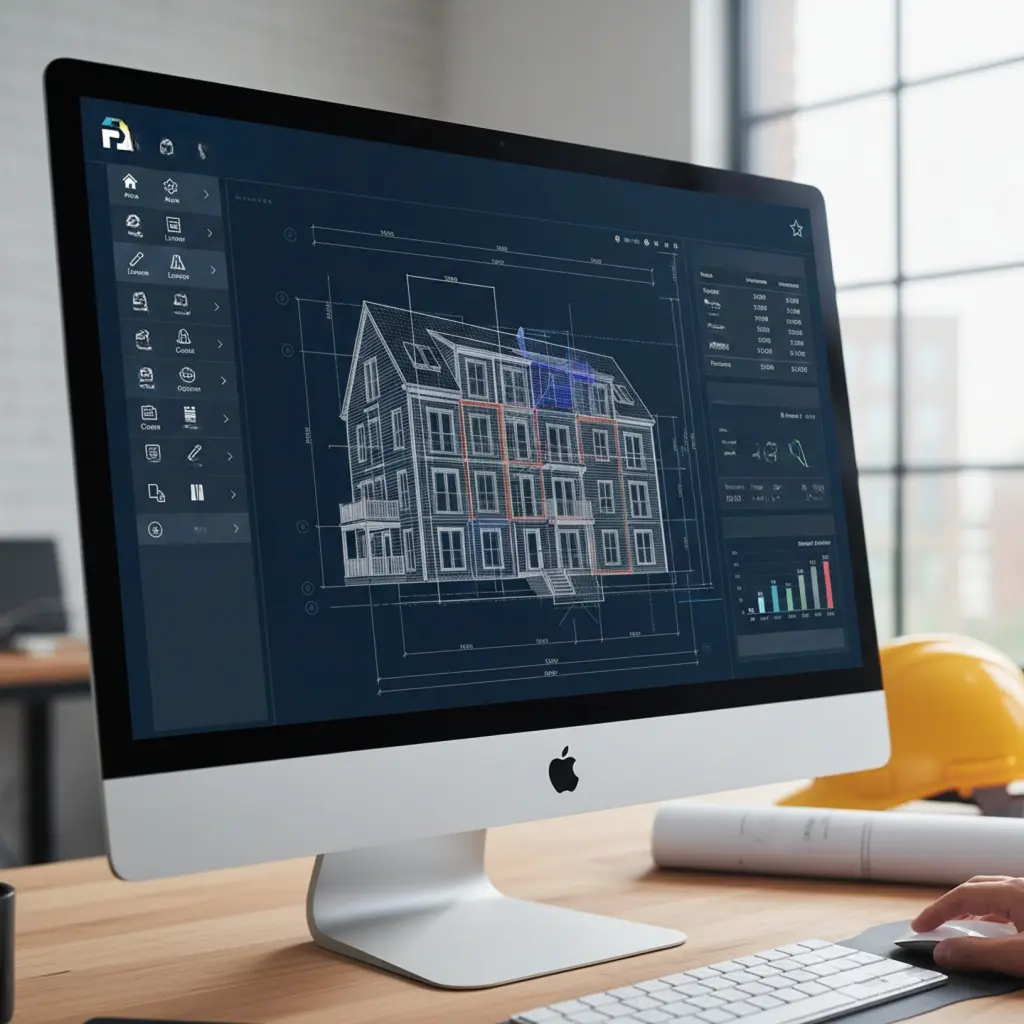
PlanSwift is a digital takeoff and estimating tool that enables contractors to estimate the material volumes and the workforce required with accuracy. Its drag-and-drop feature enables fewer errors and is quicker than the traditional bid preparation; submitting an accurate and competitive proposal is made easy.
CoConstruct
CoConstruct is a combination of cost estimation and project management, which is ideal for custom builds. Contractors are able to monitor budgets, manage the expectations of their clients, and make sure that each bid is in real terms of the project scope and cost.
Buildxact
It is a cloud-based site that assists the contractor in estimating costs, preparing quotes, and managing subcontracting effectively. Buildxact makes the process of communication easier and minimizes the chances of missing important costs, which enhances the accuracy of bids.
Houzz Pro
Houzz Pro is a product tailored to design-build companies and provides project estimation, customer service, and optimization tools. Through this combination, design and budgeting will help the contractor to make professional bids that will impress the clients with their value offerings.
Sage
Sage is a complex construction management solution that involves estimating, analytics, and reporting. Sage helps contractors to monitor the project costs in real time, competition of bids, and make the correct decisions to enhance profitability.
By incorporating these software solutions and AI-based insights and BIM modeling, contractors can not only optimize the bidding process but also minimize mistakes and present the offer in a way that not only sounds convincing but also precise. Read about how AI in Construction will help you change your bidding process and bring your business to a competitive advantage.
What Winning Bids Include in 2026?
It is not only the price when submitting a bid, but also precision, clarity, and strategic planning in 2026. Understanding what makes a winning construction bid could be the key to failure in projects and a profitable contract. Effective bids are ones that have precise calculations, are well-documented, and have realistic planning in order to show value and reliability to the project owners.
Key Elements of a Winning Bid
- Accurate Quantities
Exact material and labor costings are necessary. Contractors who use professional material takeoff services for construction projects are sure that their bids will be based on the real costs, and they are not going to be surprised by the outcomes and make a considerable profit. - Clear Scope
A bid should spell out what will be included or excluded. Uncertainty causes conflicts and a lack of confidence, whereas a clear scope of work portrays a sense of professionalism and expertise. - Risk Buffer
Giving a contingency on unexpected challenges covers both the client and contractor. Risk planning, when done properly, will help to make sure that small delays or price changes do not derail margins. - Realistic Timelines
Contractors who are able to make promises that they can keep are appreciated by their owners. Scheduling should be efficient and accurate, and not cause delays or hasty work in projects. - Transparent Pricing
Each line item in the bid must be well-defined and rationalized. Open pricing will create trust in the project owners and can make your bid stand out from those of your competitors, who will either underprice or hide expenses.
When Should You Seek Professional Bid Estimating?
In the modern competitive construction market, contractors can be disadvantaged by not having professional assistance in submitting a bid. Contractors whose performance is highly successful win contracts between 40 and 50%, whereas the industry average is 25%. This shows that strategic and data-driven bidding is not only useful but also needed to be profitable.
Why Professional Estimating Matters?
The use of professional construction estimating will make sure that each bid is based upon the factual project costs, risk factors, and resources needed. Contractors that are dependent on experts can:
- Avoid underpricing and margin erosion
- Accurately forecast timelines and material needs
- Highlight value to owners while remaining competitive
When to Consider Expert Services?
Contractors are advised to take into account construction bid estimating services in cases:
- Projects are complex or large-scale
- Multiple subcontractors and material suppliers are involved
- Profit margins are tight, and precision is critical
- Historical bids show frequent underestimates or losses
Recommended Services
Contractors may use professional estimating solutions to achieve maximum success:
- Professional construction bid estimating services: professional services to estimate the cost of construction, including material takeoffs, labor calculations, and contingency plans.
- Accurate Cost/Budget Estimating Services for winning bids: Specializes in exact cost forecasting, assists contractors in providing competitive bids to secure margins.
With the integration of these services, the contractors will stand at a competitive advantage, will have a more accurate bid, and will be able to win lucrative projects in the year 2026.
Win more profitable construction bids by start bidding with efficiency and strategy today
Where to Find Construction Bidding Opportunities Online?
Finding the right projects is the first step to winning profitable projects. Contractors are no longer able to use word of mouth or local networks as the primary source of new construction bids; the digital world has taken the reins of this purpose in 2026.
Key Platforms for Bidding Opportunities
- Government Portals
The majority of federal, state, and local projects are available on the internet. Contracts Contractors can access open bids, RFPs, and prequalification requirements through platforms such as SAM.gov (federal contracts) or state procurement websites. - Commercial Bid Platforms
BuildingRadar, Mastt, and JobPlanner are among the others that offer aggregated construction projects, and a contractor can filter them by type, location, and size of the project. These platforms usually provide approximated budgets and due dates, and they assist the contractors in focusing on lucrative opportunities. - Industry Associations and Networks
Organization membership, such as the Associated General Contractors (AGC) or the National Association of Home Builders (NAHB), may give access to projects earlier and offer exclusive bids. - Specialized Software & AI Tools
Estimating and bidding software, including PlanSwift, Buildxact, and CoConstruct, tend to incorporate bid opportunity alerts within the software, incorporating AI-generated insights with project discovery to save on time and enhance targeting.
|
Pro Tip: Combine online opportunities with accurate estimating practices like material takeoff services for construction projects to create precise, competitive bids that maximize win rates. |
Conclusion
Building a Strategy for Winning Bids in 2026
The concept of winning construction bids in 2026 is not about guessing numbers, but rather precision, planning, and maximizing the use of industry experience. Those contractors who integrate proper estimating, competitive analysis, and technology-led understanding always win more projects, maintain margins, and provide profitable construction projects.
Knowing what makes a winning construction bid, from applying AI, BIM, and professional estimating services, each aspect of the bidding process could be improved to maximize the success rate. It’s important to keep in mind that even little changes in the accuracy of bids and strategy will result in a significant increase in revenue with the same number of offered proposals.
Take Action Today
It is not about the guesses of the prices when bidding in 2026, but rather about accuracy, tactics, and experience. Contractors who embraced professional construction bid estimating services and proper cost/budget estimating solutions enjoy a quantifiable benefit.
Invest in the accuracy of your estimates, use the latest bidding technology, and make informed decisions to:
- Maximize bid win rates
- Avoid costly underestimates
- Deliver projects on time and within budget
- Secure profitable construction projects consistently
Start to be smarter and more profitable in bidding today with Estimations. Your next winning bid begins with accuracy and tact.
FAQs
What is the average success rate of contractors in bids?
The mean success rate on bids in the construction industry is approximately 25%, and most contractors only win 1 out of 4 bids. Contractors with the best performance and professional construction estimating and strategic bidding can gain 40-50% win rates. Enhanced precision of bids, the use of AI tools, and a precise analysis of the competition have a great impact on increasing success.
What is the effect of proper estimating on the construction bids?
Correct construction estimating and bidding have a direct influence on profitability. Research has indicated that two out of every five bids are underestimated, and three out of every five projects suffer overruns.
How competitive is construction bidding today?
The competitive nature of construction bidding has never been as high. In most projects, 5-8 contractors would be bidding on the project, and low bidding does not suffice anymore. Professional presentation, risk management, and accurate estimating are needed by contractors in order to be differentiated and win lucrative projects.
How can technology and AI improve construction bidding?
BIM, cloud estimating, and AI-driven insights, as well as AI and technology, have the potential to enhance the accuracy of the bid by up to 20, minimize errors, and give a predictive analysis on the most optimal prices.
What are the impacts of construction bids on profit margins?
The accuracy of bids has a direct relationship with profit margins. Profits can be destroyed by underestimating costs, contingencies, or presenting vague bids. The contractors who observe best practices in estimating, scope definition, and preparation of bids always get projects that have healthy margins.
