
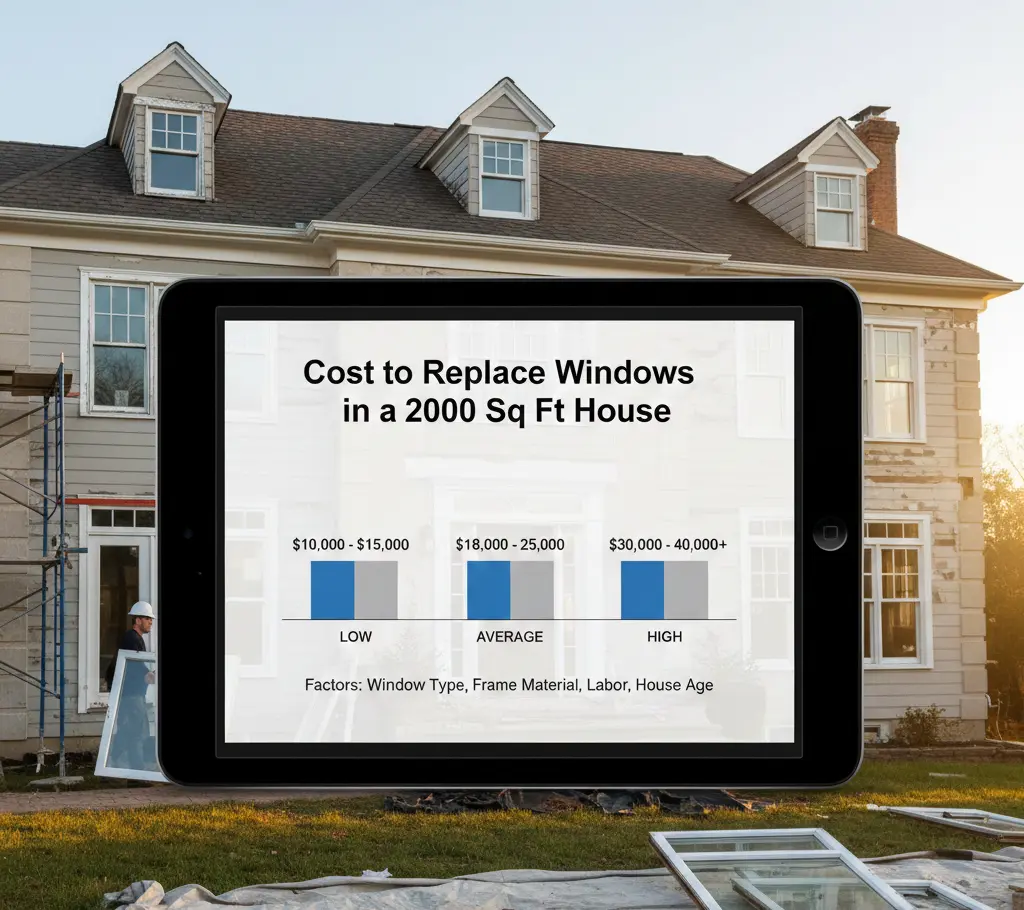
It is not just another upgrade because replacing every window in your house can make a significant impact on the comfort, bills, noise level and even resale value within a night. However, the instant homeowners begin searching for window replacement, they encounter a vexing issue like recently varying costing, imprecise estimates and excessively high and low ranges which are not reflective of actual homes. When you own a 2,000 sq ft house, those figures that you see on the internet may be disorienting, exaggerated, or missing.
And that is the reason why such a guide exists. We are not showing you generic averages but rather decomposing what replacing all windows in a 2,000 sq ft home actually costs in 2025 in realistic situations using real data and with clear explanations so that you can know where your money is going before you commit to a major investment.
What Does This Window Replacement Cost Guide Cover?
Here, you will have a complete, fact-based analysis of the real cost of what it would cost to replace all of the windows in a 2000 sq ft house in 2025, and it will include:
- Average total cost ranges for replacing all windows in a 2,000 sq ft home
- Per-window installed costs based on real market data
- Typical number of windows in a 2,000 sq ft house and how it impacts pricing
- Material cost comparisons like vinyl, wood, fiberglass and composite, etc
- Labor cost breakdowns and why installation prices vary
- Retrofit vs full-frame replacement costs explained clearly
- Real-life cost scenarios for 10, 15 and 20+ window homes
- Energy savings, ROI and resale value impact backed by verified statistics
- Hidden and overlooked costs homeowners often miss
- Frequently asked questions that homeowners search for before replacing windows

Average Cost to Replace Windows in a 2000 Sq Ft House in 2025
And if you ever looked up the price to replace windows in a 2000 sq ft house and got confused about the quotations, you are not alone. One of the websites claims that it is cheap, and the other one makes it sound daunting. So what’s the real story? We should begin by basing this discussion on confirmed national statistics and then de-institutionalize that data to see what it really represents to an actual home such as yours.
According to the national homeowner cost data collected by Angi, the mean cost of window replacement for US homeowners is approximately $7357. The average price of most projects is between $3,442 and $11,839, which varies depending on the number of windows, type of materials and installation.
Here is the important puzzle piece many articles miss:
These are not the final prices, and they are initial ones
Why is the Average Cost Only the Beginning?
That average of $7357 presupposes an average situation. In practice, costs change rapidly in accordance with:
- How many windows does your 2000 sq ft house actually have
- Whether you choose basic vinyl or premium energy-efficient windows
- Labor difficulty (upper floors, older framing, full-frame replacements)
An illustration of this is that a homeowner who has 10 of the usual vinyl window replacements might remain toward the low portion of the scale. In contrast, a house with 18-22 windows, larger opening sizes or energy efficient improvements may have costs that are many notches higher than the national average.
What does this mean for a 2000 sq ft Home?
A 2,000 sq ft house sits right in the most common replacement category nationwide, which makes these numbers highly relevant. However, instead of using one average, the wiser move is to know how such an average is assembled and how your preference alters the aggregate either positively or negatively.
And that is what we are going to deconstruct now, window counts, per window pricing, materials, labor and real-life cost situations, and so you are not just making an educated guess, you are planning. Similarly, understanding the cost to replace the roof can help you budget effectively and avoid unexpected expenses, giving you a complete picture of your home improvement investments
How Many Windows Does a 2000 Sq Ft House Typically Have?
Here is a simple question that turns a pricing puzzle fast:
How many windows do you actually need to replace? This is the step skipped in most cost estimates, but the number of windows is the never that raises or lowers your price almost as much as anything.
The Industry Standard Way to Estimate Window Count
Rather than making an educated guess, Building Science Advice recommends a universally agreed-upon rule of thumb.
Windows typically account for about 15% of a home’s total floor area
According to the advice provided with the assistance of ENERGY STAR, this ratio can be used to approximate a realistic number of windows without using approximate average values.
Using this method on a 2000 sq ft house, the average result is as shown below:
- Lower range: approximately 10-12 windows (less complexly designed, less exterior wall)
- Average range: about 14- 18 windows (average suburban houses)
- Upper range: To the extent of approximately 22 windows (higher levels, greater windows, corner rooms)
Discover materials, labor, and real estimates
Why This Range Matters for Your Cost?
Each extra window consumes material expense, man-hours, trim and installation duration. There is a difference of only 4-6 windows that can change the overall project cost by thousands of dollars.
That is why we will use a 10-22 window range wherever we are illustrating:
- Real cost examples
- Per window pricing conditions
- Comparisons between materials and labor
| House Layout / Style | Approx. Number of Windows | Notes |
| Minimal / Simple Layout | 10–12 | Few exterior walls, standard window sizes |
| Average Suburban Home | 14–18 | The most common layout includes bedrooms, living areas and a kitchen |
| Larger / Multi-Elevation Home | 19–22 | Corner rooms, large windows, extra elevations |
Window Replacement Cost Per Window Installed
Have you ever thought of how one window would run you a couple of hundred dollars, and then the next one would cost you the bank? Knowing per window costs is critical since your overall project cost is just the sum of individual window costs plus the unknown factors such as labor, material and access. According to Modernize and HomeWise figures, the prices per window installed in 2025 are between $630-$1050, with a median of $1047.
Material Type Matters
The performance and the prices of the material used in the window are drastically dependent on the material chosen. Vinyl windows are cheap and require little maintenance as compared to wood, which is warm and more demanding. Fiberglass or composite alternatives are a compromise between durability and energy efficiency. Not only is the cost per window affected by your selection, but also long-lasting maintenance and energy saving.
| Material Type | Cost per Window (Installed) | Notes |
| Vinyl | $630 – $850 | Low-maintenance, affordable and widely used |
| Wood | $950 – $1,050 | Premium finish, higher labor and more maintenance |
| Fiberglass / Composite | $850 – $1,000 | Durable, energy-efficient and mid-to-high cost |
Size and Window Style
Window dimensions and style are another major cost factor. Regular single-hung windows are popular and simple to install, keeping prices down. The larger or specialty windows, such as double-hung, bay or picture windows are more costly in terms of materials and labor and consequently, the cost of installing them is high. With the aid of your design preferences, you can turn a simple replacement into a high-end project in no time.
| Window Type | Approx. Installed Cost | Notes |
| Standard Single-Hung | $630 – $800 | Most common and easiest to install |
| Double-Hung / Sliding | $750 – $950 | Larger opening and more hardware |
| Custom / Bay / Picture | $900 – $1,050 | Specialty sizes and designs cost more |
Labor and Accessibility
The most neglected cost driver is labor. Windows on the first floor can be installed comparatively easily. Still, those on upper floors or on large specialty windows require using a scaffold, a ladder or more team which increases the cost per window by hundreds of dollars. Full-frame replacements take more time and labor as well because installers will have to take off old frames and work on the walls, which will also be a major consideration of the final price.
| Labor Factor | Cost Impact | Notes |
| Standard first-floor | Minimal ($0–$50) | Easy access for installers |
| Upper floors / tall windows | +$50–$150 | Requires scaffolding or ladders |
| Full-frame replacement | +$100–$250 | Involves removing existing frames, trim and possible wall adjustments |
Cost Breakdown by Window Material
The selection of appropriate window material is not limited to aesthetics because it is among the largest cost line item factors in your replacement project. They have different prices, lifespans, maintenance needs and energy efficiency related to each material. These differences can be understood in advance and can save thousands of dollars and avoid being caught off guard by the invoice.
The following is the impact of material choice on the per window installed costs in 2025.
Vinyl Windows, which are affordable and Low-Maintenance
The most widespread type of window is the vinyl, which is selected by the homeowners who want to have a durable, economical and energy-saving variant. They are simple to set up, have less maintenance and are usually available in a wide variety of typical sizes and colors. Although the cheapest choice is vinyl and it is possible to make the costs even higher by selecting bigger or specialty vinyl windows.
| Material Type | Installed Cost Range | Best For |
| Vinyl | $630 – $850 | Affordable, no frills and ordinary houses. |
| Tip: Vinyl will be more appropriate for buyers who are not ready to pay much for high-quality materials. |
Wood Windows Which are Classic and Premium
The wood windows have a great old-fashioned appearance which is more expensive because of the materials and the time to install. They are more costly to maintain in the long-term, sealing, staining and painting. Wood is a possible option for the homeowner who desires the beauty, workmanship and can afford it.
| Material Type | Installed Cost Range | Best For |
| Wood | $950 – $1,050 | Premium appearance, traditional homes and aesthetic appeal |
| Tip: Wood can be used in a historic or luxury home where design and authenticity are more important than money. |
Fiberglass / Composite Windows Which are Durable & Energy-Efficient
Composites or fiberglass windows are a medium to high-priced product with strength, energy saving and low maintenance. They do not warp easily and they do not swell and contract like wood and vinyl, which means that they are suitable in harsh climatic conditions. More expensive than vinyl they can be, yet can offer longer-lasting service to economize energy.
| Material Type | Installed Cost Range | Best For |
| Fiberglass / Composite | $850 – $1000 | Durable, energy-efficient and moderate-to-high budgets |
| Tip: Fiberglass will be a good option if you would like to get long-term performance and do not need to maintain it. |
Why Understanding Material Costs Matters?
Each dollar variance in material will be counted on your 10-22 windows and this will really affect the overall project cost. When you compare the use of vinyl, wood and fiberglass, it allows you to find material selection to fit your budget, style, long-term performance and not be left to guess through amorphous averages. Rival companies tend to sweep such differences under the carpet and their decomposition gives homeowners a chance to make informed choices.
Labor Cost to Replace Windows (What Homeowners Miss)
This is one of many puzzles that homeowners do not know: only part of the cost is the window itself. Labor will readily take up 30-40% of your total replacement bill but the largest cost guide only brushes over it. Knowing the cost of labor and how it is influenced is the key to budget planning your 2000 sq ft house project without any unexpected costs.
According to the industry expertise relating to the labor costs, the average labor cost per window would be between $100-$300, depending on complexity. Some of these, such as full frame replacement, high-wins, or structural repairs, can push the costs even further.
Why Understanding Labor Costs Matters?
One of the least considered yet changeable components of window replacement is labor. Being aware of what influences it, whether it is accessibility or structural work will enable you to budget properly, receive no invoices unexpectedly and schedule in advance. Competitors tend to report averages without clarifications but this breakdown gives you something you can relate to before you embark on your project.
Standard Labor Costs for Easy Access
For most first-floor windows or straightforward replacements and labor is relatively minimal. The installers do not need the use of scaffolding, ladders or much preparation. This is the case most of the guides use to compute averages yet actual homesteads are hardly so straightforward.
| Labor Type | Cost per Window | Notes |
| Standard first-floor | $100 – $150 | Easy access, no structural changes |
| Fun fact: Even such a trifle as a garden or a fence can add several additional labor hours and even more money to your project. |
Labor for Upper Floors or Hard-to-Reach Windows
The installation of windows on elevated levels or in tight spots would involve additional equipment, an increased number of team members and extra time. They are typically more expensive per window to install, with the use of scaffolding, lifts or special ladders and in some cases they require twice the amount of labor as a first-floor replacement.
| Labor Type | Cost per Window | Notes |
| Upper floors / tall windows | $150 – $250 | Precaution extra, needs scaffolding or lifts. |
| One window like that is nearly the same price as two regular first-storey installations. |
Full-Frame Replacement and Structural Repairs
Full-frame replacement is more labor-intensive because the installer removes the entire existing frame, adjusts walls, replaces trim and ensures proper insulation. Labor can get out of control if it has water damage or some structural repairs.
| Labor Type | Cost per Window | Notes |
| Full-frame replacement | $200 – $300 | Includes removal, wall adjustments, and insulation |
|
Puzzle: Sometimes the price of this step may go higher than the material price of a single window, which is why homeowners must never skip the step of detailing labor estimates. |
Retrofit vs Full-Frame Window Replacement Cost
Among the largest decisions that a homeowner could make when it comes to replacing windows is the identification of the correct method. Would you choose a retrofit window which would be put in the existing frame or a full-frame replacement which would remove the entire old window? That decision has an impact on cost, schedule, risk, appropriateness and it is not always clear what is most appropriate for your 2000 sq ft house.
Retrofit Window Replacement
Retrofit windows also called insert windows, are installed by sliding into the current frame to making the process of installation quick and less intrusive. They fit well in case you already have a pair of good frames and just need to trim.
- Cost: Moderate ($630 – $900 per window)
- Installation Time: Quick (1–2 days for standard homes)
- Risk: Low, minimal disruption to walls and trim
- Best Use: Standard replacements or minor upgrades without altering the opening
|
Pro Tip: Retrofit windows are a window facelift in a hurry: it is quick, clean and more affordable. |
Full-Frame Window Replacement
Full-frame replacement is used to install a window that takes away the complete window and frame including the trim. This process is perfect in case your frames are rotten, bent or broken or you desire to change the size of the window frame.
- Cost: Higher ($900-$1,300+ per window)
- Installation Time: Longer (2–5 days depending on complexity)
- Risk: Medium-High, may require structural adjustments
- Best Use: Damaged frames, historic homes or full remodels
|
Pro Tip: Full-frame replacements are like hitting the “reset button” for your windows and are more expensive but solve hidden issues and future-proof your home. |
Side-by-Side Comparison
| Feature | Retrofit Window | Full-Frame Window |
| Cost per Window | $630 – $900 | $900 – $1300+ |
| Installation Timeline | 1–2 days | 2–5 days |
| Risk | Low | Medium-High |
| Best Use Case | Solid existing frames | Damaged frames, resizing, remodels |
| Disruption to Walls/Trim | Minimal | Significant |
Energy Savings and ROI of Replacing Old Windows
This is one of the under-the-carpet mysteries that many homeowners are unaware of and that is your old windows may be silently guzzling your energy kitty. As a matter of fact, windows contribute to 25-30% of heating and cooling energy in a normal home. It is a big piece of money and a single upgrade will do a significant job of enhancing comfort and bills.
With the help of certified windows, the amount of energy used can be lowered by up to 13%. That can be translated into a monthly savings of $25-$50, which is often the case with a regular 2000 sq ft house, based on your weather, insulation and the efficiency of the house. In a year, that is hundreds of dollars that would remain in your pocket instead of flying out of your old, drafty frames. Knowing the average time to construct a house can also help you plan these savings and other expenses more effectively, giving you a clearer picture of your investment timeline.
However, monthly bills are not the end of the benefits. ROI is also impressive with respect to window replacement. As a survey carried out indicates, the value of a project undertaken by the homeowners at the time of reselling the house ranges between 60-75% of the cost incurred, with high-demand houses fetching up to 85% of the cost incurred in the market. This is not only an energy-saving step but it is also a good investment in the value of your home.
New windows should be treated as a twofold investment as they bring down the energy bill and increase the resale value. Even minor power-saving improvements will generate a tangible difference in comfort and make your house stand out in the market.
Real Cost Scenarios for a 2,000 Sq Ft Home
The question that all homeowners would like answered is: just how much will the real cost of replacing all the windows in a 2000 sq ft house be? The generic averages would only go to a certain extent; the actual budgets are based on the number of windows, materials, labor, and any add-ons. In order to render it understandable, we have simulated three realistic situations with proven pricing information.
Budget Case: 10 Windows
In the case of a smaller 2000 sq ft house or a basic remodel job, we will have 10 standard vinyl windows. This represents a budget-conscious scenario.
- Materials: approx $6,300 – $8,500
- Labor: approx $1,000 – $1,500
- Potential Add-Ons: $200–$400 (trim, minor adjustments)
- Total Estimated Cost: $7500 – $10400
Average Case: 15 Windows
The most common scenario for a 2000 sq ft suburban dwelling would be 15 windows with a combination of vinyl and mid-range fiberglass.
- Materials: approx $10,000 – $13500
- Labor: approx $1500 – $3000
- Potential Add-Ons: $300–$600 (trim, minor structural adjustments)
- Total Estimated Cost: $11800 – $17100
|
This is not a linear cost, as more labor and more complexity in installing the many windows are required as the number of windows becomes larger and installing upper stories or specialty sizes. |
Upper Bound Case: 22 Windows
In more massive layouts or houses with 22 windows, a combination of a mixture of vinyl, fiberglass and some wood frames around the best rooms would increase the expenses.
- Materials: approx $14000 – $19000
- Labor: approx $3000 – $5000
- Potential Add-Ons: $500–$1000 (trim, structural repairs, insulation)
- Total Estimated Cost: $17500 – $25000+
Why Window Replacement Costs Vary So Much?
This is one of the questions that all homeowners will ask when they receive an estimate and the reason why the same-sized home is priced differently. This is found in the factors that are hidden and not very well taught by most guides. Knowing these variables can allow you to plan better, not to be caught by a thing and make wise choices.
Permits and Local Regulations
The replacement of the windows is subject to a permit in some municipalities, particularly in relation to structural alterations or older houses. The permit fees are also very different and range between $50 to multiple hundreds of dollars and failure to pay the fee may involve a fine or even a suspension. Always check local rules before budgeting.
|
Insight: Permit cost might be relatively small, yet it increases overall project cost and schedule, particularly where multiple windows are involved. |
Structural Damage and Repairs
Rot, water or insulation problems may be concealed in old or worn-out frames. Replacement of the frame or repairing of walls can make labor and material costs very high. What appears to be a simple-looking window on the outside might need hidden repairs when it comes to breaking it out.
Custom Sizing and Specialty Windows
Replacement with standard windows is simpler and less expensive, whereas replacement with custom sizes such as bay windows or odd shapes is extremely expensive. Specialty windows must be fabricated custom, need more time to install and in some cases specialized tools are required.
|
Tip: If you have non-standard openings, plan and factor both time and cost into your budget. |
Local Labor Rates
The cost of labor varies according to the area, installer demand and job complexity. A high-demand location or an urban area may experience a price of $50-$150 additional per window in a rural area. The highly experienced installers might cost more, yet their knowledge can save them money in mistakes.
|
Labor cost can be just as variable or even more than materials. This is why even two quotes from the same house may vary by thousands. |
How to Get an Accurate Window Replacement Cost for Your Home?
Ever had the question of why there can be two quotes of the same home different? The trick here is to have a correct window replacement estimate is one that will consider the specific needs of your home, material preferences, labor and other miscellaneous expenses. The generic averages can be useful in planning the project but they seldom reflect the actual project-specific numbers. For a deeper understanding of how to calculate these costs accurately check out our guide on how to estimate construction costs to ensure your budget aligns with your project.
Steps to Estimate Your Window Replacement Costs
- Count and Measure Windows Accurately
- Begin by accurately measuring each of the windows, including its type (single-hung, double-hung, bay or custom). It is important to remember that sizes and styles have a great influence on materials and labor.
- Determine Material Choices
- Choose between vinyl, wood, fiberglass or composite windows. The cost of materials varies and each material possesses distinct advantages that determine the overall cost.
- Factor in Labor and Accessibility
The labor charges differ according to the level of the floor, the condition of the frames, and the accessibility. This inclusion at an early stage is to prevent budget surprises in the future.
- Include Add-Ons or Hidden Costs
- Take into account the permits, building repairs, trim and insulation improvements. Even minor items can accumulate and make a difference in your end project price.
- Use Professional Estimating Resources
- Although DIY calculators may give approximate ideas, a professional estimate would incorporate all the variables such as the rates in the regions and the complexity of installation.
|
Pro Tip: An accurate estimate is not just a number because it’s a roadmap for your project and helps you plan your budget and timeline with confidence. |
After doing your research, you can seek a project-related estimate just to know the exact cost of replacing your window. This will make sure your plan has real materials, labor and add-ons and not averages.
Conclusion
There is more than the material costs of changing windows in a home of 2000 sq ft. Whether it is the type of windows and the amount of labor put into it or concealed repairs and saving energy, knowing all this will result in an intelligent investment. With proper planning and proper estimates, homeowners can be able to maximize comfort, efficiency and future value and transform a need to upgrade into a strategic enhancement.
FAQs
How does the cost of replacing the total windows in a house of 2000 sq ft cost?
A: This will be determined by the number of windows, the materials, labor, and add-ons. Practical estimates of a home of 2000 sq ft: $7500-$25,000, including budget, average and max. Depending on the vinyl, wood or fiberglass windows and the complexity of installations, the prices are diverse.
How would I save on energy bills using new windows?
Windows that are energy efficient can save up to 13% of the heating and cooling expenses which amounts to approximately $25-$50 per month. With time, this assists in recovering part of your investment besides enhancing the comfort of the home.
What would be the better choice between retrofit and a complete frame window replacement?
Retrofit windows are quicker and cheaper and have to fit the existing frame whereas full-frame replacement includes the removal of the whole frame, which is ideal when the window is damaged or oversized. The methods have different impacts on cost, schedule and disruption possibilities.
What is the time to replace all windows in a 2000 sq ft house?
With regular 10-22 windows, the average time frame of installations is between 1-5 days depending on approach, availability and complexity. Retrofit installations are quicker and installations involving a complete replacement frame take more work and structural modification may be necessary.
Does window replacement increase my home’s resale value?
Yes. The average ROI of window replacement is one year of 60-75% and 85% on high demand markets. Well-maintained and energy-efficient windows make a good impression on potential buyers.
